Mozilla’s Continued Commitment to Open Badges

At Mozilla, we’re devoted to empowering individuals on the Web. This means creating tools and communities that teach important digital-age skills. It also means helping to build a technical ecosystem for recognizing and showcasing these skills.
In 2011, Mozilla and the MacArthur Foundation set out to create exactly this. We collaborated to build the Open Badges project, which developed an approach to reward learners with digital badges for their efforts. It’s an ambitious task: the Open Badges project aimed to spark a transformation of how we recognize learning.
The project has come a long way. Since 2011, Open Badges has developed a devoted and international community, attracted partners from around the world and demonstrated the possibilities of an open credentialing ecosystem.
The road to create an Open Badges ecosystem has also been challenging, and we’ve learned valuable lessons. Perhaps no surprise to some, we learned badges cannot exist in a vacuum — to flourish, they need active communities and compelling educational content. And we learned that building a technical infrastructure for a universal badge network is a complex task. Mozilla’s place in Open Badges is not in operating the core services that make up this infrastructure. Instead, Mozilla’s best contribution to the growing ecosystem is to play a smaller, committed role as one of many players.
It’s important to reflect on the progress we’ve made since launching the initiative.
In 2011, Mozilla and MacArthur engaged with over 300 nonprofit organizations, government agencies and others about informal learning, breaking down education monopolies and fuelling individual motivation. We also created the Open Badge Infrastructure (OBI) public beta, a technical framework for the collection and sharing of badges. Much of this work was guided by “Open Badges for Lifelong Learning,” an early working paper we created with the MacArthur Foundation. Badges became an important part of what people worked on at MozFest, as well.
In 2012, we launched Open Badges 1.0, an improved ecosystem for badges. We also partnered with the City of Chicago to launch The Chicago Summer of Learning (CSOL), a badges initiative to keep local youth ages four to 24 active and engaged during the summer. Institutions and organizations like Purdue University, MOUSE and the U.K.-based DigitalME adopted badges, and we saw international interest in badging programs from Australia and Italy to China and Scotland.
In 2013, over 1,450 organizations were issuing badges. Our partnership with Chicago had grown into the Cities of Learning Initiative, an opportunity to apply CSOL’s success across the country. We also began to develop a fully functional badge system at Mozilla via our Hive Learning Networks.
In 2014, we launched The Badge Alliance, a network of organizations and individuals committed to building the open badging ecosystem and advancing the Open Badges specification. Founding members include Mozilla, the MacArthur Foundation, DigitalME, Sprout Fund, National Writing Project, Blackboard and others. More than 650 organizations from six continents had signed up through the Badge Alliance to contribute to the Open Badges ecosystem.
Open Badges has continued to evolve. In mid-2015, the Badge Alliance spun out and became a part of Collective Shift, a nonprofit devoted to redesigning social systems for a connected world. The Badge Alliance will work in concert with another Collective Shift project, LRNG, which is creating a global ecosystem of in-school, out-of-school, employer-based and online learning that includes a technology platform for badges. With continuing support for the Badge Alliance and LRNG’s push to make badges part of connected learning experiences for youth, the Open Badges community remains active and growing. Nate Otto, Director of the Badge Alliance, leads standard development efforts, while a growing band of implementers cooperate to improve the options for using Open Badges to recognize learning across many environments.
What’s Ahead
In 2016, Mozilla will continue to support the Open Badges ecosystem we helped seed. We’re taking on a smaller role, and working alongside several players, but remain committed to the initiative. We’ll also apply what we learned: Open Badges can evolve best as a collaborative, community-driven effort. Its future is brightest when the community comes together to carry it forward.
Mozilla will continue to collaborate with the Badge Alliance and the rest of the Open Badges community. Mark Surman, Mozilla’s Executive Director, serves on the Badge Alliance Steering Committee alongside Connie Yowell and Rob Abel. Mozilla will also pass control of openbadges.org to the Badge Alliance, who will update the resource. Mozilla and the Badge Alliance will also collaborate to plan for the future of BadgeKit.org.
We will also reconsider the role of the Badge Backpack. Mozilla will continue to host user data in the Backpack, and ensure that data is appropriately protected. But the Backpack was never intended to be the central hub for Open Badges — it was a prototype, and the hope has forever been a more federated and user-controlled model. Getting there will take time: the Backpack houses user data, and privacy and security are paramount to Mozilla. We need to get the next iteration of Backpack just right. We are seeking a capable person to help facilitate this effort and participate in the badges technical community. Of course, we welcome code contributions to the Backpack; a great example is the work done by DigitalMe.
We want this to be an open and productive process. Over the next few months, we’ll be writing more, and listening, about the future of badges. We look forward to your ideas, thoughts and feedback.

Improving the X-Ray Goggles Onboarding Experience

by Kristina Shu, Mozilla Foundation designer
X-Ray Goggles has been out in the world helping people kick off their code curiosities for a couple years now, but installing them has always been a pain point for many users. Ensuring users have a seamless experience is crucial for a good first impression and continued use. This post will take a look under the hood at how we redesigned the X-Ray Goggles onboarding experience.

Designer Jam Session

Sabrina, Luke, Natalie and I got together to brainstorm. Our main focus was on usability and finding the simplest way to show users how to install and use Goggles. In the end we decided on two separate web experiences: one for installing Goggles and another for teaching people how to use it.
handdrawn sketch showing relationship between landing page and activity pageWireframe of the two separate pages:
wireframes showing content areas of install page and activity page The Install Goggles page:

annotated version of install page highlighting different content areasBrand Alignment

In an effort to align Mozilla’s brand across Foundation projects we mirrored the look and feel of Thimble’s landing page. This helps create brand awareness through continuity and makes it easier for users to become familiar with our tools. Maybe you’ll notice some similarities?

annotated version of Thimble homepage, showing similarities to Goggles, e.g. "Same typeface" Let’s Get Technical

Working with Pomax, Software Engineer at the foundation, we created simple graphics to lead users through the steps to install the Goggles bookmark. With Pomax’s mad coding skills and browser detection, we are able to determine a user’s operating system and browser. Utilizing this, the site can now offer up graphics specific to a user and the system they are most familiar with. For example:

installation instructions for Firefox on Mac and WindowsActivity Page

Now the fun part, putting Goggles to use! We decided a simple mix-and-match game was the best way to engage users and the perfect opportunity to show off Goggles features like using code to swap out images. It’s eye-catching and fun, but simple enough for a first-time user to complete fairly quickly. Sticking with the Mozilla theme we chose a fox (for Firefox of course), a dino for Mozilla and a Thunderbird. Our fox has gone on to influence further design projects, such as the end of year fundraising campaign and has been christened the ‘dapper fox’.
fox, dinosaur, and bird illustrations, and three versions with top/middle/bottom body parts interchangedTo create an integrated and interactive walk-through tutorial, Pomax was able to overlay instructional bubbles overtop of the activity. We also limited the number of steps and kept the amount of text to a minimum in an effort to not overwhelm users.

screenshot of tutorial in action, with edit pane exposed and pop-up with instructionsTry Them On

Try out the new X-Ray Goggles at goggles.mozilla.org and let us know what you think in the comments below or by tweeting @mozteach. There is always room for improvement so if you have any suggestions or want to contribute to these products, check out our repo!

SwagMail Kits with Special Guest: Research Fox

Last week, the Mozilla Science Lab released a preview of special sticker swag featuring our Research Fox, a fab design by @flukeout on the Foundation design team. 

We had such an overwhelming and awesome response, that we’ve decided to dispatch some swag packs to our community. Read on to find out more about how you can score a sticker or a swag pack.

  • If you are an open science enthusiast, we want to hear about it. You’re eligible for a sweet laptop sticker with Science Fox (we’ll send a few in case you want to share!). 
  • If you run a study group, host open science events, pilot a project on collaborate, or actively build awareness around open science, we would love to send you a little pack of Mozilla Science swag to share with your community (stickers, flyers, teaching materials). We expect that you’ll host an event, program, study group, or project in support of open science, so that you can share this swag with your community!

In either case, please fill out this form so we can learn more about you, and send you the appropriate swag: http://goo.gl/forms/Dow83mjMzT

We’ll send it to you ASAP, allow with instructions on how to share your swag receipt with the Twitterverse!

Thanks and good luck!


img-research-tweet


img-rhodyrstats


Community Spotlight: San Emmanuel James

At Mozilla, we have been cultivating a global network of web literacy leaders who are teaching and learning the most important skills of our age: the ability to read, write and participate in the digital world. Many people across the globe have joined us in this effort, and we are constantly inspired by how they bring their knowledge and experiences back to their communities.

San Emmanuel James

San Emmanuel James at MozFestEA 2015.


One of those people, San Emmanuel James, has illustrated this kind of impact by being an early pioneer for Mozilla Uganda, MozFestEA, and localization projects. We interviewed San James to learn more about his journey towards web literacy leadership. Here’s what he had to say:
What is your background with the web? With Mozilla?
Growing up, computers were not accessible to everyone, the internet was an even scarcer resource. I first interacted with the web during my high school vacation while I was waiting to join the university. My love affair with the web began when I joined the University to pursue a degree in computer science.
In my final year at university, we embarked on a project to localize Mozilla Firefox, then version 3.0 to Luganda, a local language in Uganda. At the time, we were introduced to Pootle and the translate toolkit by a team from Translate.org.za. The project was fascinating. It was exciting to do the localization and build the language packs. Mozilla Firefox in Luganda became an official build in version 3.6.
At the launch, we were joined by various guests including the prime minister and the minister of state for ICT. The Reps program and the Mozilla community in Kenya were still new. When they had about the launch, Alex Wafula led a team to join us at the launch and there after we talked about birthing a Mozilla community in Uganda. That was 5 years ago in 2011. I started the local community in Uganda and was the first Mozilla Rep.
Today, we have over 10 Reps and 2 mentors and over 40 active community members, plus hundreds of others who join us occasionally at our community events. From localization, we have contributed to other functional areas such as Webmaker, Womoz, Firefox OS, Developer Relations, among others.
San Emmanuel James

San Emmanuel James (3rd row from front, 7th from left) with MozFestEA 2015 participants.


What is your most noteworthy #teachtheweb accomplishment?
In its second year, I believe MozFestEA has been my most noteworthy accomplishment. MozFest EA has turned out to be a major launch pad for local innovations and a key platform collaboration and technological development. It has attracted the attention of local and foreign partners, as well as government. Participants come from across the region and beyond to celebrate the awesomeness of Mozilla and learn more about how we contribute to nurturing the open web. At the event we run a number of #teachtheweb sessions. MozFest EA has the potential to become the largest tech event in the region.
San Emmanuel James

San Emmanuel James speaks with a participant at MozFestEA 2015.


How are you inspiring others to #teachtheweb/join in the Mozilla cause?
By sharing my experience and the experience of others. The way we teach the web in Mozilla is novel and revolutionary in places like Uganda where learning is mostly theoretical and classroom based. Using, train-the-trainer approach and practical/illustrative learning techniques, I help new and existing community members increase their knowledge and learn how to teach others. Mozilla has a wealth of learning resources it has created over time and I have made it a point to bring these to the attention of the community members so they can benefit from it. I have been quite keen on teach.mozilla.org and developer relation resources I see impact the local community.
You can learn more about MozFest EA here, and the Mozilla Uganda community here.
Do you know someone that has made tremendous strides towards global web literacy or has made an impact through a Mozilla Club, classroom, or the #teachtheweb community at large? Share the story with us.

Mozilla Announces Expansion of Gigabit Innovation Program at US Ignite Event in Washington, DC

Today, Mozilla representatives are in Washington, DC with our partners from the National Science Foundation and US Ignite announcing the opening of the Mozilla Gigabit Community Fund for 2016. $300,000 will be made available for pilot projects that show how high-speed networks can be leveraged for learning in the two pioneering gigabit cities of Kansas City and Chattanooga, TN. From robots that can be controlled from across town without lag to virtual reality applications that transport students across the globe, Gigabit Community Fund projects will explore how next-generation technologies can make learning more immediate, equitable, and immersive. Application details and deadlines are available at https://www.mozilla.org/en-US/gigabit/apply/.
Since 2011, Mozilla has partnered with US Ignite and the National Science Foundation to move gigabit innovations out of the lab and into communities. As more and more cities benefit from high-speed networks and the national gigabit ecosystem grows, projects like the Gigabit Community Fund are critical to increasing participation in next-gen innovation. This program brings new voices into the conversation about what the future of the Web should look like and fuels Mozilla’s mission of supporting an Internet where all people are empowered, safe, and independent.

Community members beta test a Gigabit Fund project at Chattanooga’s first Mini Maker Faire. (Photo Credit: Jason Oswald)

Community members beta test a Gigabit Fund project at Chattanooga’s first Mini Maker Faire. (Photo Credit: Jason Oswald)


To date, the Fund has supported the development of 17 pilot projects in Kansas City and Chattanooga, engaging teachers, students, informal educators, and technologists of all stripes as co-creators and beta-testers of gigabit technologies.
“From relatively small grants have come huge impacts, as these projects continue as yearlong courses in our schools or even as full-fledged gigabit tech startups,” said Mozilla Gigabit City Lead Lindsey Frost. “Pilots have allowed students in these communities to collaboratively mix music, create media-rich videos that compile instantly, and even build a water-quality monitoring system that streams data in real time to local researchers.”
Gigabit Community Fund grant applicants can be companies, institutions or nonprofits eager to leverage gigabit Internet to improve education and workforce development. Though pilots must take place in Chattanooga or Kansas City, technologists and educators from all over the United States can apply, and cross-city grants are available.
Students at a Maker Party in New York test out The Gigabots, a Kansas City Gigabit Fund Project (Photo Credit: Hive NYC)

Students at a Maker Party in New York test out The Gigabots, a Kansas City Gigabit Fund Project (Photo Credit: Hive NYC)


These cross-city grants are not the only way we’re expanding the geographic reach of Mozilla’s gigabit innovation work. In partnership with the National Science Foundation and US Ignite, we’re also announcing at today’s event that we’re expanding the Gigabit Community Fund to three additional cities by 2018, with the first city to be announced in May 2016. Selected cities will receive support and staffing from Mozilla as well as $150,000 in Gigabit Community Fund innovation funding.
“There are more than thirty Smart Gigabit Communities from all over the United States represented at today’s event,” said US Ignite Executive Director Bill Wallace. “The Gigabit Community Fund presents a tremendous opportunity for them and for all gigabit communities to explore how next-generation applications can enhance education and workforce development.”
To submit your city for consideration to become the next Gigabit Community Fund city or to learn more about the 2016 Gigabit Community Fund grant cycle, visit mozilla.org/gigabit.

Mozilla Announces Expansion of Gigabit Innovation Program at US Ignite Event in Washington, DC

Today, Mozilla representatives are in Washington,DC with our partners from the National Science Foundation and US Ignite announcing the opening of the Mozilla Gigabit Community Fund for 2016. $300,000 will be made available for pilot projects that show how high-speed networks can be leveraged for learning in the two pioneering gigabit cities of Kansas City and Chattanooga, TN. From robots that can be controlled without lag from across town to virtual reality applications that transport students across the globe, Gigabit Community Fund projects will explore how next-generation technologies can make learning more immediate, equitable, and immersive. Application details and deadlines are available at https://www.mozilla.org/en-US/gigabit/apply/.
Since 2011, Mozilla has partnered with US Ignite and the National Science Foundation to move gigabit innovations out of the lab and into communities. As more and more cities benefit from high-speed networks and the national gigabit ecosystem grows, projects like the Gigabit Community Fund are critical to increasing participation in next-gen innovation. This program brings new voices into the conversation about what the future of the Web should look like and fuels Mozilla’s mission of supporting an Internet where all people are empowered, safe, and independent.

Community members beta test a Gigabit Fund project at Chattanooga’s first Mini Maker Faire. (Photo Credit: Jason Oswald)

Community members beta test a Gigabit Fund project at Chattanooga’s first Mini Maker Faire. (Photo Credit: Jason Oswald)


To date, the Fund has supported the development of 17 pilot projects in Kansas City and Chattanooga, engaging teachers, students, informal educators, and technologists of all stripes as co-creators and beta-testers of gigabit technologies.
“From relatively small grants have come huge impacts, as these projects continue as yearlong courses in our schools or even as full-fledged gigabit tech startups,” said Mozilla Gigabit City Lead Lindsey Frost. “Pilots have allowed students in these communities to collaboratively mix music, create media-rich videos that compile instantly, and even build a water-quality monitoring system that streams data in real time to local researchers.”
Gigabit Community Fund grant applicants can be companies, institutions or nonprofits eager to leverage gigabit Internet to improve education and workforce development. Though pilots must take place in Chattanooga or Kansas City, technologists and educators from all over the United States can apply, and cross-city grants are available.
Students at a Maker Party in New York test out The Gigabots, a Kansas City Gigabit Fund Project (Photo Credit: Hive NYC)

Students at a Maker Party in New York test out The Gigabots, a Kansas City Gigabit Fund Project (Photo Credit: Hive NYC)


These cross-city grants are not the only way we’re expanding the geographic reach of Mozilla’s gigabit innovation work. In partnership with the National Science Foundation and US Ignite, we’re also announcing at today’s event that we’re expanding the Gigabit Community Fund to three additional cities by 2018, with the first city to be announced in May 2016. Selected cities will receive support and staffing from Mozilla as well as $150,000 in Gigabit Community Fund innovation funding.
“There are more than thirty Smart Gigabit Communities from all over the United States represented at today’s event,” said US Ignite Executive Director Bill Wallace. “The Gigabit Community Fund presents a tremendous opportunity for them and for all gigabit communities to explore how next-generation applications can enhance education and workforce development.”
To submit your city for consideration to become the next Gigabit Community Fund city or to learn more about the 2016 Gigabit Community Fund grant cycle, visit mozilla.org/gigabit.
 

#TeachTheWeb Reflections from 2015

The team that oversees Mozilla Clubs, Hive Learning Networks, Maker Party, MozFest and all things web literacy and #teachtheweb recently came together to reflect on 2015–to share major highlights, key learnings, and what we’re looking forward to in our work in 2016.
A few highlights from 2015:

  • We launched a brand-new program with Mozilla Clubs. The first cohort of Regional Coordinators joined us in January and helped us cultivate growing interest from partners and participants across the globe. By the end of the year we counted 150 Mozilla Clubs and 28 Regional Coordinators.For more, read: Mozilla Clubs Year End Reflection
  • We released a new site! In April, teach.mozilla.org was launched as a place to find free activities for teaching web literacy skills, as well as information about Mozilla Clubs and other programs.
  • We re-released Thimble with lots of updates and user-centric features. Over the past few years, this became a popular tool for educators and others to create and remix content on the Web. We’ll continue to make improvements to this educational code editor that helps people learn and play with HTML, CSS and Javascript.
  • We won a Digital Innovation in Learning Award! Mozilla Hive Chicago was awarded the Better Together DILA Award for their amazing work to improve the Chicago community by cultivating web literacy leaders who advance reading, writing and participation in the digital world.

  • We launched a localization campaign to bring web literacy to more languages and locations around the world. We started with Web Literacy Basics I–comprised of six activities that are now available in 10 other languages including Bengali, Hindi, Portuguese, Swedish and others – all available soon on teach.mozilla.org.
  • The sixth-annual MozFest — Mozilla’s celebration of the open Web — convened hackers, teachers and organizers from across the globe to address some of the most pressing issues facing the Web today. Together, we explored how we can act as leaders in the tech, policy and social spheres to create a better Web for everyone.
  • We furthered our commitment to Gigabit cities and the web’s future by expanding the Gigabit team and our partnership with the National Science Foundation.

Children at Mini Maker Faire Chattanooga, which showcased Gigabit Community Fund projects


Some important things we learned and re-confirmed along the way:

  • We are at our best when we listen to our community and focus on what value we can add.
  • Our local communities are open to experimenting with new tools, exploring new ideas and being incredibly productive in the process.
  • It’s important to communicate our challenges and ask for help creating solutions.

What we’re looking forward to in 2016:

  • Expanding on our efforts to localize more content and curriculum to reach broader audiences.
  • Continuing to improve our Mozilla Clubs program by offering more resources and support.
  • Growing Gigabit to new cities by building processes and systems for a seamless expansion. Building Connected Credentials work with Hive NYC organizations and partners to think, examine, share and produce documentation and big thinking about doing connected learning in trusted environments.
  • Offering Leadership Curriculum 1.0 and launching Web Lit Map 2.0 on teach.mozilla.org.
  • Working more closely with other programs like Mozilla Science Lab and Open News to share best practices and identify new opportunities and experiences for web leaders across various contexts and interests.

We’d love to hear about your #teachtheweb reflections from 2015 as well as what you’re looking forward to this year. Share your thoughts with us on our community forum.

Mozilla Science Lab on the Road: Yack/Hacking at Hive Chicago Buzz

This past week-end, the Mozilla Science Lab-mates traveled to Chicago for Hive Chicago Buzz, the second-annual event hosted by Mozilla’s Hive Chicago Learning Network, aimed at activating projects that solve problems in education. Spanning two venues in Chicago’s Pilsen neighborhood, the Jan 22-23rd event included a kickoff evening with lightning talks from local Chicago education partners, and a full hack-day with morning workshops and afternoon project work-sessions. For those unfamiliar with Mozilla Hives, they function as parts of the Mozilla Foundation, much like the Science Lab, but with a more regional focus and with an emphasis on supporting educational networks that link standard and alternative learning in a honeycomb of city-based programs. The Hive Buzz is one among many events they sponsor to build their network.

tweet-comp

There were some great talks by the Chicago Architecture Foundation, the Chicago Public Library, and reps from various education programs in Chicago schools, and perhaps what was most interesting, was the amount of science! The event drew participants from the Adler Planetarium, the Chicago Academy of Sciences, the Science Chicago – Life’s a Lab organizing crew; it featured a inter-generational crowd of students, educators, and service providers with peripheral if not direct backgrounds in physics, chemistry, and the arts.

 blue

For our part, the MSL helped with setup and some on-site logistics, and hosted a 90-min workshop and 4-hour work-session on mapping education/participant data for the Hive networks. We tackled questions like “where are areas of need or neglect for educational programs?,” “what census and demographic data might help us understand the communities that our programs serve,” “how does travel to educational institutions affect attendance?,” “where are the most advantageous locations to host community events, and how can we publicize those hosting locations to the network?.” After a morning workshop on open source mapping tools, we built a solid team of nine Hive members and visiting helpers who worked to define some goals and build some mapping prototypes. 

mapping-wkshp

After some moderate struggles with weak internet, we split our team into task forces of specialized roles: some of us collected relevant data to apply to our maps (locations of libraries/schools, population distribution, census tract info), some of us worked on the routing and distance calculations to determine travel time between event sites on public transport, some of us worked on the visual schema for the resulting visualizations. For offline work, we discussed the use of Stamen’s Field Papers to collect data with kids on the ground, and bring it back to some web-maps for study and processing.

img-field-papers

You can check out some of our travel-time prototypes (demoed with travel-time distance to the Adler Planetarium and the Peggy Norbert Nature Museum) as well as our mapping workshop materials in the links below. 

Special thanks to Stuart Lynn of CartoDB, and David Bild of the Peggy Notebaert Nature Museum for their help in facilitating our session and gathering session materials, and to all coordinators of Mozilla’s Hive Chicago Learning Network for organizing such a fantastic event.

tweet-msl

Why did you decide to donate today?

This year, we asked some of our donors why they decided to donate to our end of year fundraising campaign.

The Survey

Screenshot of the survey questions

Screenshot of the survey questions

The Audience

The survey was shown to a random sample of donors whose browser language was set to en-us, en-gb, or en-ca.

Below, you can see the traffic source/medium for EN language users who donated. The survey results are not segmented by traffic source, but this data gives you an idea of the population who saw the survey. These are predominantly Firefox users.

donor_source_medium

Below, see the geographic location of people who completed the survey:

survey_response_locations

The Results

Why did you decide to donate today?

reason_for_donation

We did a manual text analysis to categorize the ~1k ‘Other’ answers:

Other_reasons

Anything else you’d like to tell us? Yes!

Approximately 6k out of the 17k people who responded to the survey left comments in the open text field. Spending time reading through these comments is both humbling and inspiring as it brings to life the many many human beings who supported this campaign, and who are critical to Mozilla’s success going forward.

In total, there were 85k words of feedback. It’s a novel.

It’s easy when reading so many comments to notice only those that are very different, so we analysed a sample of the results to group the messages by sentiment.

anythingelse

That gives you a feel for the tone of the messages overall.

While working through this sample, I made a note of comments that stood out to me. This selection is looking for an inspiring (rather than a purely representative) sample.

  • Absolutely LOVE your work! Please keep working on staying as independent as possible without all the snooping built in.
  • Keep it up. You guys are fulfilling a sacred mission.
  • Thank you for your contribution to keeping the web open to all, and helping to ensure that it is not reduced to being a puppet of big business.
  • I have been told that you are the safest web browser. Thank you for all that you do.
  • I also believe in what Mozilla is trying to do and its only right that we should all give a little to help, maybe more over time.
  • Thanks, I love you all!!!
  • This is free software, which I’m usinfg now for quite some time. does its job to my satisfaction. Words like free-web are new to me. I never thought about this subject before.
  • Thank you for being an alternative browser and for your mission to keep the internet open.
  • I am grateful to Mozilla and if I wasn’t off work with a fractured hip I would donate more.
  • My most favorite browser for 7 years already, keep up the good work guys.
  • I trust my data is safe with you, one reason I don’t sign up/give on line readily is that I hesitate to share my data widely.
  • I watched Do Not Track, which I found through mozilla, and it was amazing!!
  • As a web designer, I find Firefox the easiest to test my applications on and, for family browsing, also the most convenient. Keep up the good work!
  • The freedom of the WWW is one of the most important human rights that we as people could have, so it should therefore be protected.
  • I love you.
  • The projects like increasing web literacy are really important to me. And the idea that there can be equity in access and voice on the internet. And I believe that I can vote with my dollar, and I need to support the things which I think are valuable.
  • While the world goes to hell in a handbasket around us with CISPA, ACTA and all the other bills and surveillance is at an all-time high, Mozilla is a flagship of hope.
  • Both reasons above. And besides, I like you guys. You got right smart guts as my grandma used to say.
  • Mozilla Developer Network is my number 1 go-to source for references. Thank you all for the wonderful work.
  • In these times of our freedoms being rapidly taken away, we need to be assured that our internet is protected from elements that want to take it away.
  • The mission is valuable but the product is good, too. You need both. Keep up the good work!
  • Thanks for your hard work! I would like to donate more, but I am retired and it is difficult these days. Anyway, your company is great. Thanks again.
  • Thanks for not being corporate slaves. It’s hard to do that nowadays
  • I’ve grown accustomed to yr face, and like the way it works.
  • I still have a Netscape Beta T shirt…. I did have a Netscape email address. Thanks…
  • Great campaign. Good luck! Merry Christmas!
  • I use Firefox everyday – for work, for recreation – it’s the best browser out there (as far as I’m concerned) and I really appreciate all your hard work.
  • A great product and the structure of the organization makes me hopeful that an open internet may still be possible!
  • I’ve been using Firefox for almost 10 years now & it’s my default browser of choice. Thank you all for being awesome.
  • Not easy to trust services in today’s world, but we do trust Mozilla Firefox. This is a thank you for your trustworthy service.
  • After finding FireFox, better yet, Mozilla maybe 7-8 yrs ago, I’ve not gone to another. I love the vibrancy of this site. I do read what is going on with Mozilla. As I progress, I want to give to this non-profit.
  • I believe in the value of services that Mozilla provides its users. I’m proud to be part of that partnership.
  • Don’t let up, Keep the internet ours and fight those who want to abuse it or abuse us on it.
  • Just thank you for being there.
  • I am an independent investigative journalist who works, for free, to offer complete information to my audience in the name of informed personal choices and the freedom to make them. I like your mission but more important I, along with every individual on the planet, NEED this. Keep being the good.
  • I greeted your convention at Orlando airport. I was very impressed with the people that I talked to!
  • You do you, Mozilla.
  • Hope you reach your desired sum & continue to offer humanity a great alternative!
  • At least Mozilla tries to preserve the shreds of privacy left to us on the internet, would love to use a Mozilla search engine one day…
  • I’ve read what you all are trying to do and I support your cause, and from the sound of your prompts, you guys and gals are struggling money wise? No? Well, either way, I hope you gain the ground needed to advance.
  • Firefox is very useful to me. Please stop Windows 10 trying to get me to stop using Firefox. It’s wrong they should do this.
  • Independent thinking and doing is important.
  • I just like the idea of you
  • Keep up the great job you are doing with Firefox. The people really need an independent browser that is designed to protect their privacy.
  • i wish every body understood what you are trying to do.
  • Mozilla seems to listen to what people want. It then makes appropriate changes to keep us safe. Keep it up!
  • Honestly, I couldn’t survive without Mozilla, Wikimedia and NPR, so I donate to help keep them alive.
  • i have learned to depend on a free and open internet. This expansion of inclusivity is an important step in the evolution of civilization.
  • Thank you for providing an alternative for my iPhone and my Mac.
  • You are keeping the web worthwhile as a workplace, an open space and safe space. thanks
  • Thank you for your dedication to your mission.
  • My son is studying for his PhD in computer science & recommended that I support Mozilla.
  • The ‘please donate’ blurb made me feel I should donate cos I use Firefox all the time and every little bit from many thankful people makes the mission happen.
  • Thanks for serving the average citizen instead of selling us out.
  • I have always loved Firefox and appreciate the way it allows me freedom to use the internet and gives me tools so I may customize my experience. I feel it works for Me not “Them”. It’s Great!
  • I am a disabled 76 year old with limited mobility. My computer connects me to the world and to my friends. My life would be very diminished without your services.
  • i too work in a non-profit and i know how difficult it is to do good work and yet funding doesn’t come in unless asked. Keep up the awesome work!
  • Security is the webs greatest challenge. I hope your organization continues to work to create avenues that provide greater and greater security to those of us navigating the wild west we call the internet.
  • You guys rock! This is the first software project I am donating to!
  • I like the way you presented your privacy policy. Very organized, with clear and direct language.
  • Go get em!

Most common phrases:

phrases

Most common words:

common words

We have a lot to live up to.

Sparking co-design with local youth

Later this month, Mozilla joins local educators and community sponsors from central Virginia to support SPARK, a two-day hackathon for fifty young people interested in problem-solving with technology. Day one begins with a ‘learnathon’ of STEM workshops on topics like agile development, design thinking, and web literacy. There’s a break in the action mid-afternoon when sponsors, like Mozilla, pitch problems for participants to solve using their leveled-up skills from the learnathon. That evening, attendees split into teams and begin brainstorming solutions to their adopted problems before calling it quits for the night.

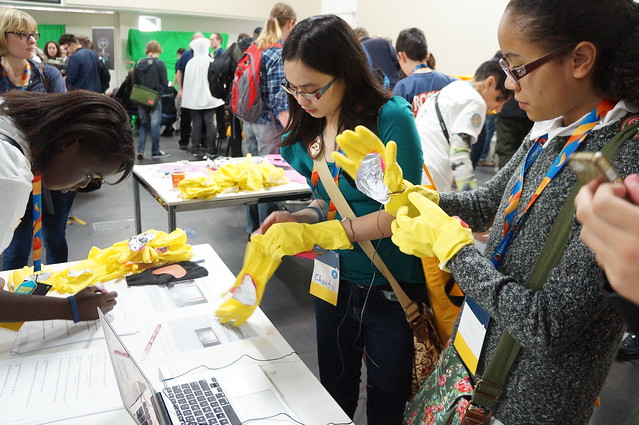
An image of young people hacking wearable sensors on gloves

Youth hacking on wearable sensors, CC-BY-SA Hive NYC


On day two, teams reassemble to iterate and test solutions until it’s time for the closing ‘Presentation expo,’ a celebration and exhibition like the MozFest Science Fair.
Inspired by the Royal Foundation’s conservation-themed Minecraft mod #wearetherangers, and by Hive NYC’s Hunger Games-themed Hungercraft events, the Mozilla Foundation is sponsoring a problem called “Fight for the Open Web.” Here’s a bit of the pitch:

…what would Minecraft be like without the Open Web? What if there wasn’t a way to get online or share your adventures, maps, mods, and servers with others? What if a company shut Minecraft’s doors to anyone who couldn’t pay an extra free (or who wouldn’t accept ads in their dungeons) for every block they mined, message they typed, or skin they downloaded? What if Minecraft was only for YouTubers with at least 100,000 subscribers and a dozen sponsors? What would Minecraft be like on the ‘Closed Web?’
After you adopt this problem, you’ll research the Open Web and then design prototypes of game assets for a map, mod, and/or resource pack called, ‘Fight for the Open Web.’ The big idea is to represent the Open Web inside Minecraft and to use the game as a tool for teaching others about how the web works through adventure, exploration, narrative, and play.

Minecraft is not only a massive online, global community – it’s an educational juggernaut that spirals players through learning basic recipes for in-game survival through setting up and modding servers that greatly add to or alter the course of normal play. It’s a deeply responsive educational platform that rewards exploration and graduating to new levels of play and meta-play that can involve manipulating the game’s code, itself.
Even as we develop a dynamic web literacy curriculum with a distinctive, participatory, and Mozilla-like style, it’s important to acknowledge and employ other web literacy technologies, like Minecraft, that engage countless users in learning through online community and game-play experiences across all types of devices. We want to go where our users are. We want to teach and learn with them in ways that are locally and individually relevant to their interests and affinities. Our SPARK hackathon sponsorship gives us the chance to do just that.
Working with local partners in central Virginia and teenage designers and developers from area schools, we’re going to start learning what’s possible in community co-design around a Minecraft experience that teaches players what’s at stake when we fight for the Open Web IRL. What does open mean to you? What does the web look like in your eyes? What makes for a compelling, game-based call-to-action in defense of a web that should remain a public resource open to all?
We don’t know how all of this looks to the next generation of web citizens, but by working alongside them through events like SPARK we plan to prototype and share increasingly dynamic, interactive, and relevant web literacy experiences that surpass our own notions of curriculum and our own place in time.
Look for an update – a lots of inspiration – soon!