Ajit Varma on Firefox’s new AI controls: ‘We believe in user choice’
 March 5, 2026

This is an edited transcript of an episode of Outside the Fox, Firefox’s flagship podcast, where we explore what’s happening online and why it matters. Stay up to date by subscribing on YouTube, Apple Podcasts, Spotify, or your favorite podcast app.
On Outside the Fox, my co-host Kim Horcher and I spend a lot of time talking about big shifts on the web, but also the quieter product decisions that shape everyday internet life. In this episode, we sat down with Ajit Varma, Head of Firefox, to talk about AI controls, our philosophy behind product decisions, and building a browser around user choice.
Steve Flavin:
Ajit, welcome to the podcast. We’ve had you on before — but for those who might be new to the show, could you give us a little intro?
Ajit Varma:
Yeah, thanks for having me. It’s always great to talk to you. As Steve mentioned, I’m the head of Firefox. I’ve been at Firefox for about a year now. And it’s been a great year as we’ve really launched new features, and I feel like we’ve really gotten back to basics of creating the best browser.
Kim Horcher:
So let’s get to it. Can you give us a quick overview of the new AI Controls in Firefox 148?
Ajit:
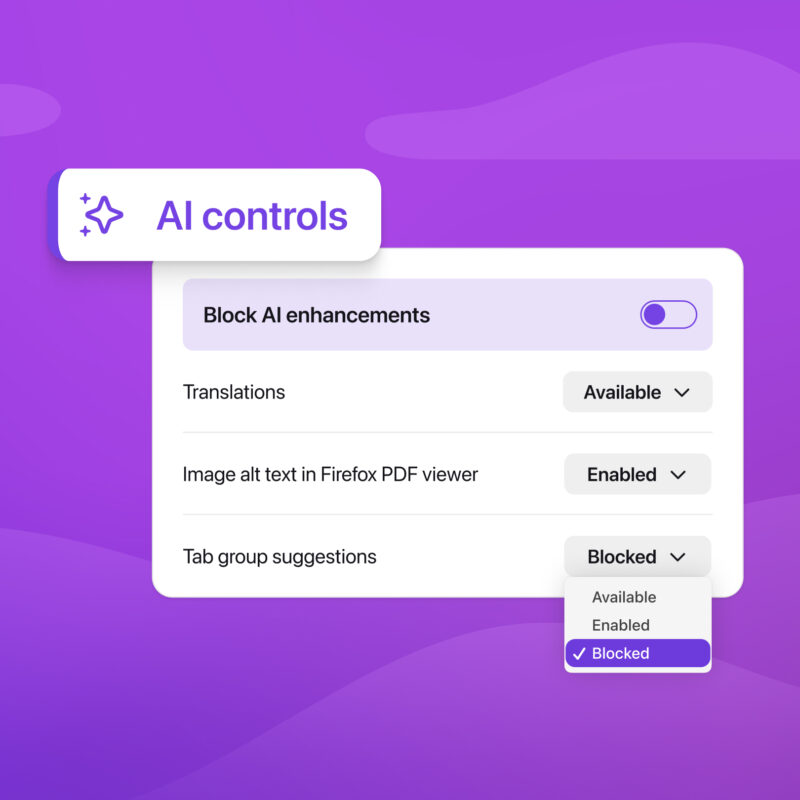
AI Controls is a simple one-stop destination where users who have preferences in how they use AI can easily make their choices. This could be to completely turn off AI, turn off all notifications about AI features, any future features, or have more fine-grained control if there’s specific AI features that you might want. And then it’s really trying to make it easy for users to create the browser experience that they prefer.
Kim:
Awesome, thank you for breaking that down. What I want to know is: why is Firefox launching this now? What problem is Firefox trying to solve?
Ajit:
Over the last year, we’ve started to introduce a few AI features into Firefox. And when we build features, we really listen to our community on how we can build a better product. And as we launched a few of these features, it was clear that for some users they did not want to use AI now or in the future. And the reasons vary a lot between people, but some are societal concerns, some just don’t feel like the feature is the right feature for them. And so as we heard this feedback, it became clear to us that we could do a better job of helping these users turn things off if that’s what they wanted. And so that was kind of the reason behind us prioritizing this work.
Steve:
We love that. I know that we’ve been working on these features for some time. And I’ve got to say, the implementation is super simple and straightforward. I also really appreciate how customizable it is. Can you elaborate a little bit on the specific features you can control in this new hub, and how you developed the UI?
Ajit:
This was a question that we spent a lot of time on, because there isn’t one definition for AI. It means different things to different people. There are features that have existed in Firefox for a long time that people didn’t really consider AI—the world evolves. And so we spent time talking to our users. We spent time looking at the technology behind the features that we launched, and we came up with a set of features that we think best aligned with people’s concerns around AI.
So these are features like translations, which allow you to go to a website and translate the content into a native language of your choosing. We had a feature in our PDF editor that allowed creation of alternative text to help people with accessibility needs understand what the image was about. When you hovered over a link, we would provide summarizations of the content on that page as an optional feature.
And then there are features that we launched in the last year like tab groups that we wanted to make more intelligent by helping users automatically organize tab groups with fewer clicks and suggesting titles by looking at the content of tabs.
With all these features, there is now the ability to turn all of these off, but it’ll also apply to future features as well. So in November, we talked about Smart Window, which is a new mode that allows even more AI innovation. But if you decide that you want to use this AI Control feature, then future features we build will also be turned off by this toggle, and we wouldn’t notify a user about any of those upcoming or existing features as well.
This was very informed by feedback that we heard. We encourage feedback from our user base and anyone who uses Firefox. If you feel like there are other features that you expected or other ways we can make this easier, please send us that feedback and we’ll continue to improve the feature based on it.
Kim:
Out of curiosity, what happens if a user chooses to block all features inside AI Controls? And is it reversible if I happen to change my mind?
Ajit:
Yeah. So, if you go to the page, there’s a toggle at the top that you can flip on or off. If you choose to flip it off, then all the features that would be in this AI bucket would then be toggled off. So if you tried something in the past and you decide you don’t want it, this is a single spot that would remove all those features.
But if you decide to use this feature and there’s one feature that you want to turn back on — say translations because you’re traveling — you can come back and just turn on a specific feature. Or if you decide that AI is something that you want, you can flip everything back on and you’ll get notifications of upcoming features.
We’ve tried to make it a choose-your-own-adventure. It’s not paywalling things or putting users through hoops. It is very user-friendly and gives people the ability to choose and control how they use AI, if at all.
Steve:
Something I’d love to touch on is this moment in the browser space.
People are talking about browsers again. That’s cool. They’ve always been relevant—but in recent years, they’ve come to be viewed almost as a kind of utility. Whereas now, there’s a lot of experimentation happening, particularly with AI browsers and AI functionality.
Across the industry, it’s generating a lot of conversations, some might even say a lot of noise. What would you say is the key differentiator of Firefox’s approach to AI?
Ajit:
First off, I’m so happy about the competition and the conversation. That goes back to Firefox’s roots. We were one of the first browsers that provided competition to an entrenched competitor, and this is what ultimately moved the internet forward.
But it’s important for us to talk about what makes Firefox differentiated. For us, that is about choice, control, and privacy. These values go to the core of the mission for Firefox, which is to help create a healthy and open internet.
When you look at other browsers, whether newly emerging ones or existing browsers changing into AI-first browsers, it’s becoming apparent that some are not being created because there’s a desire to create the best browser. Many companies are looking at how to take users’ data, how to get more adoption for AI, how to create more entry points into that company’s AI.
At Firefox, we have a singular mission: to create the best browser. We don’t have billions of dollars spent on building an LLM that we need to force upon users. We believe in user choice. That can mean using on-device models. It can mean choosing the AI you want and not just the AI of the company who built the browser.
Steve:
That’s exciting to hear. As all of us are navigating this new landscape together—as AI reshapes the web as we know it—how do you view Firefox’s role? How can Firefox lead by example?
Ajit:
With any new technology, there are going to be pros and cons. Some we can anticipate, and some we’ll adjust to as we see what users want.
We think there are AI features that can improve the browsing experience. Translations can create better connection and empathy. Accessibility features can make the internet more accessible to more people. We’re looking very thoughtfully at how we launch AI features to make sure they create better experiences.
But we’re also focused on features outside of AI. Over the last year, we’ve launched tab groups, vertical tabs, sidebar. We have customizable hotkeys and split view coming. And over the next few months, we have many privacy features launching.
I’d say this is probably the most exciting roadmap I’ve seen in years as we get back to the basics of creating the best browser. We’re excited to hear from users, and build something that serves everyone’s needs.
You can watch or listen to Outside the Fox on YouTube, Apple Podcasts, Spotify and other major podcast platforms.