

MozFest 2014 Opening Keynotes
Speakers at Saturday morning’s opening keynote session:
- Mary Moloney, CoderDojo
- Mark Surman, Mozilla Foundation
- Michelle Thorne, Mozilla Foundation
Speakers at Saturday morning’s opening keynote session:
Many thanks as always to our speakers for our monthly lab meeting: Brian Bot (Sage Bionetworks), Aure Moser (a Knight-Mozilla Fellow and contributor to Internews Kenya) and Laura Paglione (CTO ORCID), for their comments on working at the intersection of science and software, and on plans for the fast-approaching MozFest!
Also many thanks to Amye Kenall (BioMed Central) for her insightful blogpost on the need for badges in science – this is exciting work we’re all eager to jump into with Amye and her team at MozFest.
And last but not least, thanks to Shirish Goyal for submitting the first (of many!) pull requests to an open science project via our new collaboration pilot, collaborate.mozillascience.org. Looking forward to many more from all of you!
The big news landed on Thursday: Software Carpentry has been spun out into the Software Carpentry Foundation! The Science Lab joins the wider community in being thrilled that this champion project has found its feet in its own organization, and we are excited for the opportunities this brings to reach more students and scientists around the world. The Mozilla Science Lab will continue to enthusiastically support the Software Carpentry Foundation with organization, instructor training, and outreach going forward – read more on our blog post from earlier this week, linked above.
This week also saw the triumphant launch of the Mozilla Science Lab’s first collaboration program! This project has been a long time coming – it got its start back at Strange Loop and LXJS 2013 as Interdisciplinary Programming, when it was proposed in a call to action by Angelina Fabbro (Mozilla) and our own Bill Mills. Since then, the project has evolved into a study on how researchers, coders, educators and designers can all collaborate to build science together – and it’s only the beginning. We have a number of events planned surrounding this project, and even bigger things to come in the new year. For now, we hope you can find a project or two to jump into and hack on – all the scientists behind these projects are eager to work and learn with you. Check out the list, and don’t be shy to jump on the forum for questions and conversation surrounding all our projects.
Also this week, it was time for our monthly community call! With so many exciting things happening this month, we had no shortage of things to discuss. Brian Bot joined us from Sage Bionetworks as one of the project contributors behind our collaboration program to tell us about lessons learned by his org in getting scientists and developers to speak the same language and work effectively together; Aurelia Moser (Knight-Mozilla fellow, Internews Kenya) told us about her plans for MozFest to start a conversation on how to adapt existing software workshop material for librarians; and Laura Paglione (CTO, ORCID) joined us with comments on ORCID’s role in badging for scientists, and how people can jump in to that work with her at MozFest.
Next week is round three of Instructor Hangouts! In response to your feedback, we’ve adjusted the times to avoid the weekend and give Asia, Australia and their time-zone neighbors some overlap with the North American community – we’ll be meeting on Thursday, October 16 at 9AM and 4PM PDT (UTC-7). Up next week, we’ll be taking another run by popular demand at instructor video reviews, and we’ll be discussing how to plan a flexible lesson for a workshop, that can most readily adapt to student needs. We hope you’ll join us!
Also next week, the Science Lab’s director, Kaitlin Thaney, will be speaking at the National Cancer Institute Center for Biomedical Informatics and Information Technology Speaker Series. Kaitlin will be speaking on how we can better work together to advance the mission of more open, collaborative, web-enabled science, and how, together, we can influence the culture of science by demonstrating new and open ways to conduct research on the web. Watch Kaitlin’s talk live via the WebEx link in the announcement, or catch the webcast afterwards.
Some exciting conversations are happening on the Mozilla Science Lab Forum! A few notables this week:
How can we advance the scientific discussion process? In this thread, @wehlutyk presents some exciting ideas on what a platform for a more fluid discussion around papers, figures, data and analyses might look like. Interesting points were raised on what we can do with the tools we already have, how to motivate adoption of new paradigms, and how we can design & build the metadata infrastructure that will underpin them.
Cookiecutter examples of good scientific software project schemes. @codersquid riffs off an issue opened by Daniel Chen on our ongoing Code Review material in suggesting the compilation of some cookiecutter templates for exemplifying standardized project layout in various scientific subdomains. This sounds like a cool and doable project – add you proposed schemes to the list!
Gold Standards in Open Science: @DamienIrving pointed out that while there’s a lot of discussion surrounding defining and advocating open science, one resource that would be really helpful is a list of great examples of open science being done out in the wild, in various disciplines. Know of any great examples? Add them to the discussion!
Have another idea, question or conversation on open science? Feel free to start your own, we all want to hear from you!
(comments welcome)
UC3, PLOS, and DataONE join forces to build incentives for data sharing
It’s time for another round of Instructor Hangouts! Join us at our new times this Thursday, October 16 at 9AM and 4PM PDT (UTC-7) to discuss all things software workshop instruction.
I received a lot of comments after the last round from people who said they wish they could have jumped in for our video review & feedback session we ran in the evening – we’re going to take one more run at it, and as advertised, we’ve got a new timeslot a bit earlier in the day and also now on Thursdays so we don’t run into the weekend for other timezones. Also this time, we’ll run the video review at both sessions to accommodate everyone. We’ll watch the video together during the hangout, but if you’d like to have a look yourself, it’s up on YouTube. Per community suggestions, comments will be synthesized (by me) into a play-by-play and posted to the video for offline review afterwards. If you have any other teaching videos you’d like to review with the group, post them in the comments or on the forum linked below.
Also on the docket for next time, I’d like to discuss strategies for planning flexible lessons. The Software Carpentry Instructor Training advertises the concepts of Reverse Instructional Design, and formative assessments for adjusting to learner’s needs in situ; have you ever tried reverse instructional design for a workshop? Or, however you design your lessons, how do you keep them flexible enough to adapt to learner’s needs as you measure them? What have you tried for assessing learner’s understanding live, and how has it gone? Are you looking to improve your lesson planning technique, but not quite sure where to start? Ask us your questions, tell us your stories, give us your comments and we’ll learn from each other’s experiences. Also, feel free to peruse the lessons and ideas I’m beginning to compose on the topic here – it’s pretty sparse at the moment, but more to come very soon! I hope you’ll join us there!
Links!
Etherpad (with connection details – we’re still on Google Hangouts)
Mozilla Science Forum – Hangouts Section (Post discussion ideas, videos for review, comments and requests here!)
We recently kicked off the Hive Challenge on Crowdrise , a month-long fundraising campaign to support non-profit organizations that are working to prepare youth for success in a digital age.
Thirty non-profit organizations from Hive communities in NYC, Chicago, Pittsburgh, Chattanooga and Kansas City are participating in this first-ever, cross-Hive fundraising effort, and they’re raising money for a variety of causes, including:

Hive Learning Networks champion digital skills and web literacy through connected learning. Non-profit organizations that are part of these city-based learning laboratories design and implement innovative programs and practices that advocate for creative learning and change. They are museums, libraries, coding clubs, makerspaces, community centers and afterschool programs, and they need your help to sustain their efforts and build impact.
Mozilla is showing its support by contributing $50,000 in prize money, available to the organizations that are participating in the Hive Challenge. In addition to the funds each organization raises, they’ll have the opportunity to win additional cash prizes–through grand prizes and weekly bonus challenges–ranging from $1,000 to $15,000.
The first weekly bonus challenge is already underway, and any organization that raises $250 this week will be entered to win an additional $1,000 from Mozilla. New bonus challenges launch every Tuesday until the Hive Challenge wraps up on Monday, November 4th at Noon ET.
Please consider donating to some of these exciting Hive programs that are doing great work to spread web literacy and equip young people with valuable skills, confidence and a true maker spirit.
This is the eighth post in a series featuring interviews with the 2014 Mozilla Festival “Space Wranglers,” the curators of the many exciting programmatic tracks slated for this year’s Festival.
For this edition, we chatted with Paul Oh, Christina Cantrill, Chad Sansing, Antero Garcia, and Jane Park, the Space Wranglers for the Build and Teach the Web track. Participants in this track will keep the web wild through hands-on making with innovative tools and teaching the web as a commnunity.
What excites you most about your track?
We have a rich array of sessions planned that cover an incredible range of web building and teaching possibilities, from hack days with youth in a science center to game building. And all our sessions will radiate around a central hub of making, building and collaborating, focused on the idea of teaching what you build—in other words, helping others see what it is that you yourself make. Anyone passing by the hub is welcome to drop in, hang out, mess around, and geek out with us!
Who are you working with to make this track happen?
We have an amazing set of facilitators from organizations around the world. A couple of highlights: the folks involved with Inanimate Alice will be launching their next session as part of our track. CoderDojo will be engaging people at MozFest with their amazing work. As will Creative Commons. As will engineers and educators from Mozilla itself. We could go on and on–the list of incredible facilitators feels endless!
How can someone who isn’t able to attend MozFest learn more or get involved in this topic?
You can follow the hashtag #mozfest on Twitter, of course. And also #teachtheweb. We’re also planning for the possibility of a Live from MozFest through Educator Innovator so stay tuned for more info!
Head on over to the MozFest site to register!
This weekend was one of firsts — first flight, first time leaving the US, first time eating Thai and Indian food, and my first event as a Mozilla Rep. I’m exhausted, and my calves are very sore, but the Vancouver Hive Pop Up was entirely worth it.
I flew in from Seattle, where my aunt drove me up to Vancouver. All things considered, everything went well — and I’m now comfortable enough with airports to fly internationally. (MozFest 2015, here I come!) Admittedly, I got a little turned around, but Helen Lee picked me up at Yaletown Station and we headed over to the Mozilla office for Webmaker training. I’ve wanted to visit a Mozilla space since I was a kid, so it was a very cool experience. The fact that I was there for a Mozilla function, as a Rep, made it all very surreal and awesome.

I met some very cool Mozillians there — specifically Dethe Elza, Luke Pacholski, and Simona Ramkisson. Luke ran us through the Appmaker training, and I was surprised by how extensive Appmaker really is. Previous to this, I’d played with it a few times, but it never really progressed past basic one-or-two-button stuff — and Luke had an entire music demo going.
After the demo, we went back to the apartment, which I was sharing with Robby Sayles and Regnard Raquedan, as well as Regnard’s wife Liza and their daughter Lizzie, who’s a little less than a year old. We ended up with all of the extra pizza from the training in our fridge (but all of it was gone by the time we left!). It was very cozy, with a breakfast nook perfect for curling up with a book in the morning.
 On Saturday morning, we had breakfast with Helen, Dethe, and their families, then set to exploring Vancouver. It’s a beautiful city. I like a more overcast, cool climate, and I love urban background noise — which is weird because I’m from a small town — so I fell in love with the city pretty quickly. We took a photo by the Olympic torch, then took a bus tour around town — and in the process, found out that Lizzie finds my face extremely amusing.
We spent a lot of Saturday discussing Reps stuff — the different events we’re working on, MozFest, and why we love being Mozillians. At one point, I referred to ReMo as “a bunch of ninja superheroes”, and I think that’s the essence of why I love being a Rep so much. We’re really this team of scrappers, unexpectedly kicking butt, with our open-source and collaborative superpowers.
Sunday was the most fun I’ve had in a long time. In the early afternoon, Robby and I went to brunch while Regnard and family poked around the city a bit more. We went to this awesome Thai bistro, which looked fairly traditional — but they were playing Paramore and indie rock the whole time. I’d never had Thai food before, but I really enjoyed it.

The event itself was a blast. We set up at the Vancouver Public Library around 2 pm, and the event ran from 3 to 6. We had about 120 people there, quite a few of them being kids. There were four or five Appmaker stations set up, but it wasn’t enough, so I started pulling kids to an ad-hoc station I set up with my MacBook. I had four kids I worked with, in groups of two — Charlie and Hendrix, and Eric and Viktor. I saved the makes they did to my VancouverPopUp collection in Appmaker, and emailed them links to the apps, encouraging them to continue development on them. (And, of course, I made sure that they went home with a Mozilla lanyard, stickers, and a Firefox button!)
I got home yesterday, absolutely exhausted but oddly re-energized and ready to run my first MozCoffee in a few weeks. High fives to all of the participants for a job well done, and big hugs to Robby and Regnard & family for keeping me out of trouble over the weekend. :)
One thing’s official — I have the coolest non-job on the planet.
This is a repost from Michaela’s (Mozilla Rep, Michigan) Caffeine and Star Stuff blog.
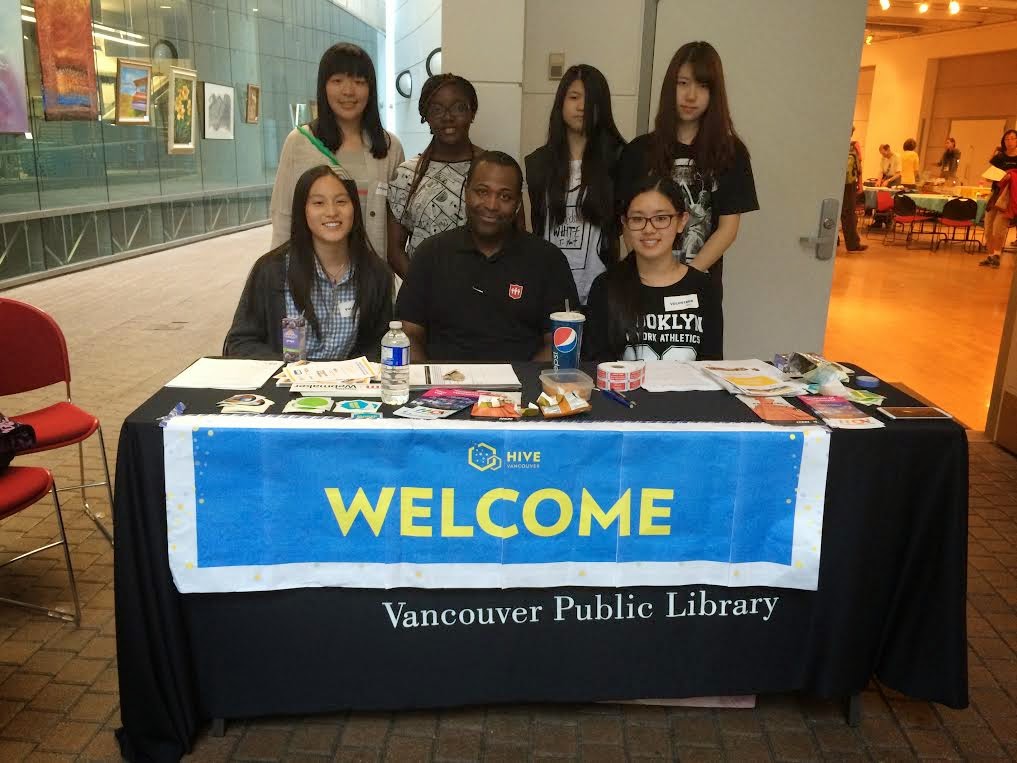
I had the opportunity to attend Vancouver’s Hive Pop-Up on October 5 in British Columbia. Vancouver community recently joined the Hive Learning network, which is a global constellation of communities championing digital skills and web literacy through connected learning. It was Vancouver’s first ever Hive Pop-up, celebrating hands on digital literacy for makers all ages. The 3-hour event featured five activity stations. The stations among the Pop-Up was Museum of Vancouver, Open Media, Vancouver Public Library, Mozilla Webmaker and Vancouver Community Laboratory. The participants were able to try virtually on garments from their latest exhibition from the Museum of Vancouver station. At our Mozilla Webmaker station, you learned how to make your home webpage, interactive videos, remixes, mobile apps.
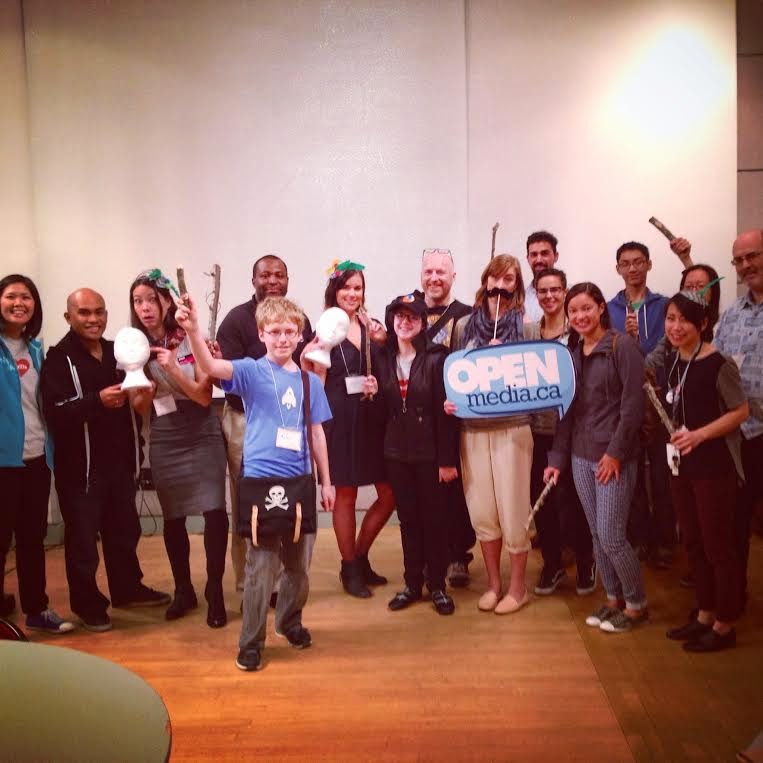
Now, speaking on Mobile Apps, when we first arrived on Friday night, we attended a training session with Mozilla Webmaker Appmaker. During the training session, we learned how to be creative on making apps and publishing them online. It was a great learning trip to Vancouver; I certainly learned a lot and I appreciate Mozilla for allowing to me learn in the process of helping others along the way
This is a repost from Robert Sayles’s (Mozilla Rep, Chicago) Mozilla Stories blog.
Software Carpentry has been around for a long time, a labor of love of Greg Wilson and many others. With support from the Sloan Foundation, the Mozilla Science Lab has helped it to grow such that, in the past year, we’ve reached more than 4,000 researchers and librarians worldwide and trained over 195 instructors (from the sciences and library sciences) who carry the torch and run Software Carpentry workshops on their own. The expansion of the community makes us excited to announce the creation of an independent Software Carpentry Foundation. This new organization is dedicated to fostering the growth and evolution of Software Carpentry work while giving the hundreds of contributors and institutions who’ve helped shape it a direct role in governing the project. Greg, naturally, is stepping into the project lead role.
What this means for you
Mozilla Science Lab will continue coordinating bootcamps and train-the-trainer programs, so from a user perspective, nothing really changes. Over time, as the new foundation gets its feet, we may transition some or all of the coordination to it. In the interim Bill Mills, the Science Lab’s community manager (and Software Carpentry instructor) with the help of Arliss Collins, the Lab’s Training Coordinator, will ensure that we keep delivering great programming around the world. If you want to seize the opportunity to play a larger role in the Software Carpentry governance, please reach out to Greg.
Mozilla is thrilled to be a partner with the new Software Carpentry Foundation. We believe that this community and the organization has a key role in the building awareness and technical capacity, so critical to the open science movement. Congrats to Greg Wilson and the rest of the Software Carpentry team, and many thanks to the Alfred P. Sloan Foundation, the Software Sustainability Institute, the University of Melbourne, the Lawrence Berkeley National Lab and NumFOCUS for their support.
For more on today’s announcement, read the press release at the Software Carpentry website. Want to get involved in helping train the next generation of open, web-enabled researchers? Get in touch.
On Oct. 23, more than 1 million people around the United States will take part in the 15th annual Lights On Afterschool campaign. It’s an effort lead by the Afterschool Alliance to celebrate afterschool programs and their important role in the lives of young people, their families and communities.
Mozilla is excited to be a partner in this initiative! We created the Lights On Afterschool Webmaker Challenge–a fun activity that gives practitioners and youth in afterschool programs a chance to unleash their creativity—and learn some coding—by making their own digital afterschool posters using Thimble, our educational code editor.

We want educators and young people to see the web as a platform for creativity. Digital media and technology are constantly changing the way young people learn and interact with the world around them, and it’s vital that we provide them with the skills and know-how required to read, write, and participate effectively on the web.
The Webmaker Challenge is a simple, fun activity to help afterschool programs develop students’ webmaking and digital literacy skills. Staff and students will design their own digital poster to share the things they love about their afterschool program, while also learning a bit of HTML, CSS and concepts including remix and collaboration.
We created a step-by-step teaching guide to help afterschool facilitators and practitioners through every step in the process. They’ll work with students to share and reflect on their afterschool experiences, then they’ll create poster sketches, choose media and other images, remix and publish their digital posters! You can do this project as a group with one computer, or in teams if you’re fortunate enough to have multiple computers. If you can’t access the Internet, you can always try an activity from the Lo-Fi No-Fi Kit instead to teach other web literacy skills.

As an added bonus to participation, six programs that participate in the Lights On Afterschool Webmaker Challenge will be chosen at random to win $500! Select the box for the Webmaker Challenge when registering your event for Lights On Afterschool, or complete the activity and earn the Web Literacy Skill Sharer badge to win. See more here.
At Webmaker, we’re experimenting with a method that allows people to log in without a password by using a handshake over email or text message instead. Our goal is to reduce the frustrations that come with password management for our users. We also aim to reduce the security risks that come from weak and stolen passwords.
Webmaker will launch the new login experience soon. Check back here for updates, or join the discussion on Discourse.
 Like many of you, we grew tired of passwords long ago. It’s a challenge to make them strong and a daily hassle to remember them. We often hear news of passwords stolen, even from tech-savvy companies with very sensitive information.
We wondered – why do we still use passwords? Aren’t there better ways to log in?
A quick search revealed that a growing number of people ask the same questions. Below, we discuss some of the existing password tools and alternatives, like Lastpass and social sign-on with Facebook. We share details on our ideas and solution to this problem. But first, here’s the short version of where we landed.
For Webmaker’s platform, we designed a different experience for log in. New visitors can join simply by entering their email address and choosing a username. They can immediately explore Webmaker and use the tools, confirming their account later.

When people return to the site later, they log in with two steps. First, they identify themselves with their email address or username. Second, Webmaker reaches out to them with an email that includes a link to log in. If they check this email on a phone and want to log in on a desktop, they can copy a short key instead. No passwords to forget. No passwords to steal.
We added another nice feature to make Webmaker even easier to use. The log in email actually offers two links: “Sign in”, which is great for public computers, and “Sign in & remember me”, which lets you stay logged in on your home computer or other devices. Once you enter the site, there’s no need to check a box that says, “keep me logged in.”

We started this work like we start most projects, by asking obvious questions. Why do we log in to sites? What do passwords do for us? We found that people log in for two primary reasons: to identify themselves and to keep other people and spambots out of their accounts. A password is a portable way to uniquely and secretly say, “Hello website, this is really me.” Passwords can do this, but they are not the only way to identify ourselves and prevent other people from pretending to be us.
One day Kavita created an account for a new site, knowing she probably wouldn’t return for months. When asked for a password, she mashed her keyboard like a cat playing a piano. A friend next to her stared and stuttered, “But, how will you get back in?” She replied, “I’ll just reset the password like I do for every other site that I use only a few times a year.”
 At Webmaker, we considered experiences like Kavita’s and wondered: what if we skipped the password and deliberately used the password recovery process instead? Could we turn it inside out, reduce the clicks, and make this annoying experience a positive one? If so, an answer to broken passwords might be hiding right at the center of the problem.
As we explored this idea, we quickly learned that other people have written about this as well. It seems that a few sites do something similar for mobile users. This solution recycles existing technology and experiences, and just requires some careful design to make it smooth. At Webmaker, we decided to push the idea further and make it our primary form of login.
You can read more about the design of the system and the user experience in a post by Matthew Willse.
Is this secure? The system rearranges existing technology and experiences to help us avoid the weakest links in our security: weak passwords, vulnerable password storage, and passwords that somebody repeatedly uses on many sites. It is more secure than the most commonly used current solution.
If designed and documented well, this solution could be useful for other sites as well, eliminating the burden on people who run web services to keep passwords secure. This approach reduces the need to maintain code for social sign-on services, and it decreases the vulnerability of stored passwords. The links and keys emailed to each user are temporary and expire after short interval or after repeated attempts to use them. You can find a more technical discussion of this in a post by Chris DeCairos.
Many efforts to make the web more secure make it less friendly to use, proving that technology only provides one part of good security – savvy design is often better than brute force. For example, some sites require longer and more complex passwords which only increases security in theory; people will find shortcuts that make things easier for themselves but less secure. They might use familiar words and dates, or repeat passwords across sites. They might keep passwords on their desk, or worse, their computer’s desktop.
Social sign-on using Facebook, Google or Twitter offer one alternative to identify ourselves. But while social sign-on offers convenience, it puts our privacy in the hands of a few companies that arguably know too much about us and our life online. Social sign-on can also be inconvenient for people who use public computers at a library or use shared devices with their family. Nobody wants to log out in order to log in. For site developers, social sign-on can also be a challenge to maintain as the implementation varies between services and periodically changes.
Services that store and remember your passwords, like Lastpass, are only a partial solution; they can’t help Webmaker and other sites keep your passwords safe. And like social sign-on, they can also be difficult for people who use public computers or shared devices.
Right now we support email. We plan to also support phone numbers and SMS for an easier log in experience with mobile phones. We also made passwords optional, smoothly offering a different experience to users based on their preference. We are curious to see which option users prefer, and why they prefer it.
We will continue to test this system across a range of scenarios and devices and iterate improvements. We welcome your feedback, ideas, and bug reports. Post your questions in Discourse or bugs in bugzilla.