

AI has changed how we browse. Full stop. The real question is whether AI leads to one browser experience for everyone, or gives people more ways to make the browser work for them.
Firefox was always built to give users an alternative to the status quo, and our approach with AI is no different. Much of the industry is going in another direction: Company A builds the browser → and the search engine → and the AI model → and all the surrounding services. The seduction lies in how effortless every layer feels, but it also means one company has total influence over what tech you can use and what AI delivers.
We aim to deliver users a different model: one where AI makes your browser empowering and helpful, with visible citations and with a zero-data-retention commitment, all powered by an independent browser engine. To get there, we’re partnering with people who align with the same open, choice-first thinking that’s shaped Firefox from day one.
Today, that starts with Exa.ai, a search and retrieval company built for the AI era.
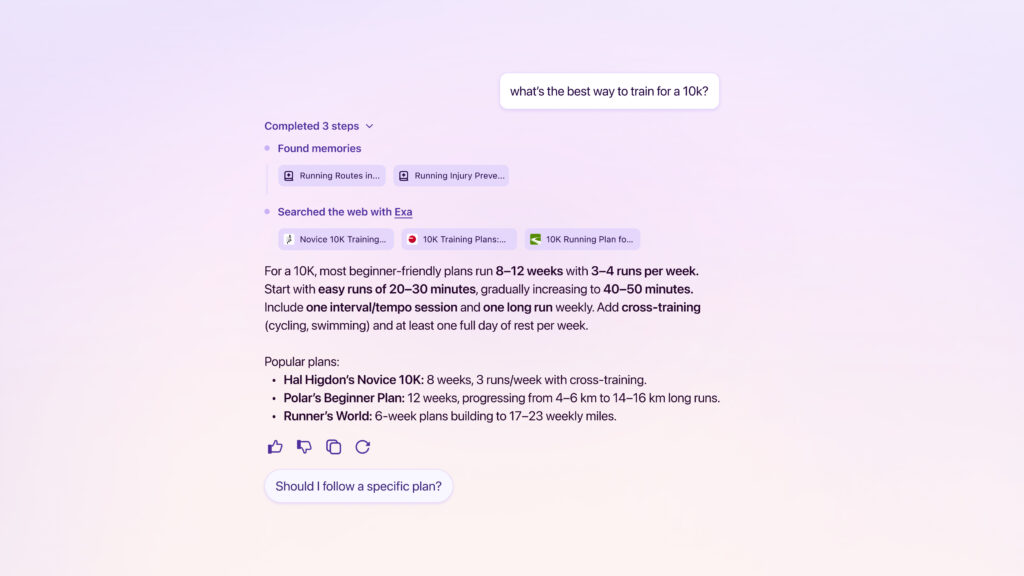
Going forward, Exa will help power Smart Window on desktop and Quick Answers on iOS, giving people a way to get current, source-backed answers without leaving the page. More on our related Smart Window announcement here.
But our Exa news isn’t about one feature or product. It’s about model choice and how people find things online.
An independent AI model
Mozilla has always believed the web is strongest when it encourages technology competition and variety, and we think the same principle should apply to AI. We want to create an AI ecosystem that is open, diverse, and grounded in the same values we champion for the web. So, instead of building our own closed AI stack, Firefox is investing in partnerships with companies like Exa.ai to bring deep expertise in specific areas while sharing our commitment to user choice, privacy, and transparency.
As Ajit Varma, Head of Firefox, puts it, “Firefox’s philosophy is straightforward: the open internet is a critical resource and people should be able to shape it to their needs and preferences — even as new entry points like AI emerge. AI should be responsible. It should stay transparent and under your control. AI shouldn’t be an-all-or nothing offering, but rather built so users can pick and choose the model or system that works for them.”
The idea is simple: Mozilla builds the browser people trust, and partners like Exa.ai bring the specialized pieces that make it better. That lets us move faster without asking people to give up what made Firefox different in the first place.
Adds Will Bryk, Co-founder and CEO of Exa.ai, “Search built for the AI era doesn’t work if it’s locked inside one company’s stack. Firefox is one of the last browsers that isn’t trying to own the model, the search, and the browser all at once. That’s why this partnership makes sense to us. We’re building the information layer for an agentic web, where trust and transparency are paramount. We share those values with Firefox, making this partnership a very easy call.”
AI should make the web more useful, not replace it
AI is only as useful as your ability to check its work.
That’s the point of building Exa’s retrieval into Firefox: when you get an answer, you can see the source it came from. Nothing is buried in a ‘citations’ menu, but sitting right there so a two-second glance tells you whether to trust it or read more. We’re not forcing you ‘just trust us’ that it’s right.
It’s a small design choice, but it matters. It’s the difference between an AI that tells you things and one that shows you where to look. It also means the people who actually wrote that content don’t disappear from the picture, the way they often do when AI summarizes and moves on.
Looking ahead
This won’t be the last partnership like it. We’re picking partners for the same reason each time: people who think AI in a browser should work for you, not the other way around.