New Report Reinforces Gig City Focus on Access and Inclusion

Earlier this month, the office of Chattanooga Mayor Andy Berke released the first report by the Chattanooga Forward Gig, Technology, and Entrepreneurship Task Force.  This report is the product of many months of studying how Chattanooga has responded to and grown from its status as the city with the fastest, most pervasive, and least expensive gigabit service in the western hemisphere.  The report points to many successes Chattanooga has experienced in becoming the “Gig City” – including the city’s partnership with Mozilla on the Gigabit Community Fund – but also lays out some key challenges for our community going forward, most notably digital access and inclusion for all Chattanoogans.  The report also recommends the creation of a public-private partnership to direct Chattanooga’s gigabit efforts and to better communicate what our next-generation network can do for our local innovation economy.

It’s exciting that as a result of this report, a new organization is being formed to help shape the important ongoing conversation about what a gig can really do for a city.  Since we launched the Gigabit Community Fund in early February, I’ve been meeting with Chattanoogans every day to have exactly this conversation as we explore what the gig can mean for our community’s classrooms and informal education spaces.  These meetings resulted in the 20+ applications that were submitted by Chattanoogans during the Gigabit Community Fund’s spring application window, which closed last Friday night.  Though these proposals have yet to be fully digested, scored, and reviewed, all could potentially help us to answer the task force report’s call to create “actual, practical demonstrations and applications of [Chattanooga’s] digital assets to help people understand.”

Not all of the applications we received ask for funding to support the next showstopping gig app or to host the newest high-profile tech demo.  In fact, a lot of the proposed projects are about applying existing technology in a new setting or thinking about a common tech tool in a new way, and that’s awesome because as we begin to search for new, practical demonstrations of our digital assets, it’s not only about finding cool ways to use 1024 MB/second but also about finding ways to do old things better, more inclusively, and more openly without ever having to worry about the limits of our connectivity.  The proposed projects are also awesome because, by taking place in classrooms and in informal learning organizations,  they’re exposing whole new groups of Chattanoogans to our next-generation network.  In so doing, they begin to address the task force report’s important call for increased digital access and inclusion and build critical capacity for Chattanooga’s technology future.

Though project funding decisions won’t be announced until mid-April, the conversation about what the gig can and should mean for Chattanooga’s educators and students continues, especially as the larger community conversation about our innovation economy grows louder.  Our city is becoming a living laboratory in which to explore how gig networks impact lives and learning in classrooms, in libraries, in boardrooms, and in every other space in which Chattanoogans work, connect, and learn.  Chattanooga’s Gigabit Hive Learning Community is creating a network through which to spur innovation in this living lab and develop connected learning opportunities that cross the boundaries of formal and informal learning spaces in the Gig City.  Through this community, we can spread the impact of Mozilla Gigabit Community Fund projects beyond their pilot audiences and begin to create opportunities for all Chattanoogans to benefit from the gig as they create and remix on an unlimited web.   Your voice is needed in this vibrant learning laboratory as we pilot, play, and test.  Come to a meetup, share what you’re doing and learning with us on Twitter, and get in touch.

Application Window Now Open for Spring Pilot Period

You helped us kick off the Mozilla Gigabit Community Fund in Chattanooga and Kansas City – now it’s time to submit your great ideas!

The application window for the Gigabit Community Fund’s Spring Pilot Period is now open.  Applications must be received by Friday, March 28, 2014 at 11:59:59 PM PT to be considered for the first round of the Fund.

Review the official Fund Rules, Terms, and Conditions here.

Once you’ve reviewed all of the fine print in the above document,  follow these instructions to apply for the Spring Pilot Period!

1.  Complete the Applicant Form – click here to get started

2.  Compile your Fund Proposal and email it as PDF (no larger than 10MB) to gigabit@mozilla.org.  Your submission must be received by Friday, March 28, 2014 at 11:59:59 PM PT.  Please use Subject = Fund Proposal – [KC or CHA].  In CHA, please copy Lindsey at lindsey@mozillafoundation.org on your submission.  In KC, copy Kari at kari@mozillafoundation.org. 

Fund Proposals should be formatted on standard letter-sized layout (8.5-by-11 inch) with 1-inch margins, with a standard font no smaller than 10 points in size. Use this pre-formatted template to ensure you have all the mandatory criteria and requested formatting.

We encourage you to get involved in your local Gigabit community — we want to help you create a strong submission!   Email us at gigabit@mozilla.org, follow @MozillaGigabit for updates, and check out our wiki for information about upcoming community calls and events.  We look forward to working with you on your proposal!


Building Gigabit Hive Communities in Kansas City and Chattanooga

Earlier this month, we launched the Gigabit Community Fund in Chattanooga, Tennessee and Kansas City.   In both cities, the Fund will support a growing Hive community of teachers, informal educators, nonprofit leaders, and technologists engaged in building new, connected learning experiences with immediate community impact.  It will help turn these two communities with some of the fastest connection speeds in the country into “living laboratories” in which to study how advanced networking can support teachers, improve student learning outcomes, and break down barriers between formal and informal educational environments.

Chris Lawrence, Senior Director of the Mozilla Webmaker Community, kicks off the Kansas City Event.

Chris Lawrence, Senior Director of the Mozilla Webmaker Community, kicks off the Kansas City event.
Photo: Kari Keefe

Appropriately, both launch events took place in public libraries – community institutions that have long connected formal and informal learning spheres.  Along with the National Science FoundationUS Ignite, and the Department of Education, the Chattanooga Public Library and the Kansas City Public Library were critical event partners, helping draw more than 200 participants in each city.

The mayors of each metropolitan region also rallied to make these launch events successful.  In Chattanooga, City Mayor Andy Berke and County Mayor Jim Coppinger spoke to a standing-room-only crowd about realizing the potential of the Gig City’s next-gen network for education and workforce development. In Kansas City, KC Missouri Mayor Sly James and KC Kansas Mayor Mark Holland addressed the public benefit of gigabit applications and emphasized the need for action now to sustain their city’s unique position in helping to lead gigabit development.


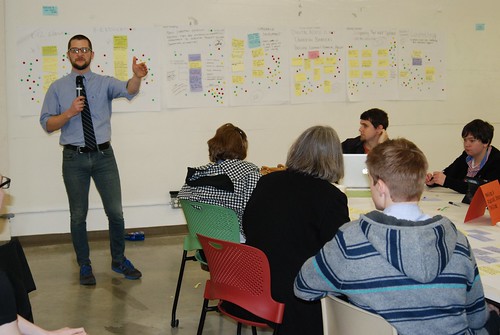
Chattanooga facilitator DJ Trischler leads the afternoon brainstorming session.
Photo: Mary Barnett / Chattanooga Public Library

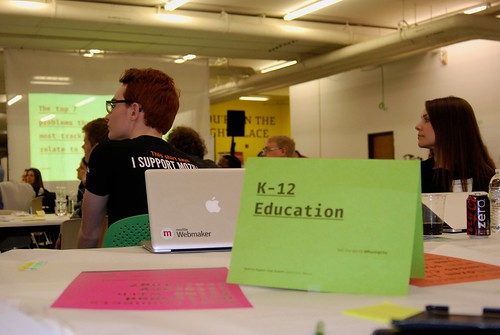
After a morning of speakers and panels focused on the national opportunities created by next-gen networks, the afternoon sessions at both launch events turned to mapping specific community challenges in education and workforce development that the Gigabit Community Fund and a broader Gigabit Hive could begin to tackle. Once divided into six interest-area tracks such as digital inclusion and K-12 education, the 200+ event participants in each city plastered the walls with both specific obstacles (“I don’t know how to integrate coding in my 4th grade classroom”) and broad community hurdles (“not all schools have gig access”). Connecting across tracks, interests, and professions, community members began to form teams to imagine solutions to shared challenges–solutions that could soon become Gigabit Community Fund projects.

Chattanooga participants at work discussing K-12 education.
Photo: Mary Barnett / Chattanooga Public Library

Activated and connected through these launch events, teams are now working to build out these projects for when the Gigabit Community Fund application window opens in late February.  Among many percolating ideas, teams are beginning to explore how to connect schools across the two gigabit cities, how to make museum content available to a broader audience, and how to connect schools with IT support as gig access is expanded.


Mike Brown (L), Alex Greenwood (R), and the Lifelong Learning track at work in Kansas City.
Photo: Brainzooming

Are you interested in helping make one of these projects a reality, or do you have other ideas to share about how to catalyze change for education and workforce development in Chattanooga or Kansas City? Even if you missed out on the launch events, there are still many ways to get involved:

  • Help us drive, design, and develop new Hive communities in Kansas City and Chattanooga! We’re looking for local classroom teachers, nonprofit leaders, informal educators, developers and designers. Don’t worry – you don’t have to know how to code or how to explain advanced networking! You don’t even have to know what a gig is! Email us if you’re interested, and we’ll be happy to help get you connected.
  • Sign up for updates about the Gigabit Community Fund, including news on applications dates and deadlines.
  • Join our monthly community calls and meet-ups to share ideas, ask questions, or offer expertise.

A Message from Keith Marzulo, National Science Foundation

Keith Marzulo, Director of the CISE Division of Computer and Network Systems (CNS) at the National Science Foundation (NSF) discusses US Ignite and the benefits of gigabit technologies for the kick-off of the Mozilla Gigabit Community Fund in Kansas City.

We’re especially excited about the Kansas City learning Hive that Mozilla will be catalyzing since it offers the opportunity of citizen engagement in the process of developing and trying out new approaches to local and national problems. And by connecting with a partner city of Chattanooga, we will be able to establish a community of practice and demonstrate for the nation the potential of these ultra high-speed networks.

Mozilla Gigabit Community Fund: Supporting Local Innovation in Chattanooga and Kansas City

Exploring the potential of advanced networks

Today we’re proud to announce the launch of the Mozilla Gigabit Community Fund—a project in partnership with the National Science Foundation (NSF) and US Ignite, that will support local innovators in Chattanooga and Kansas City as they build real-life open source applications for gigabit networks.

The Fund will help transform these cities into “living laboratories” for experimentation and development of public benefit uses for gigabit technologies. Mozilla will establish Hive Learning Communities in Chattanooga and Kansas City, similar to its Hive Learning Networks in NYC, Chicago, Toronto and Pittsburgh, where organizations collaborate around shared goals in digital learning and making, and economic opportunities.

The Gigabit Community Fund follows the Mozilla Ignite Apps Challenge program, which supported 22 teams working on gigabit app prototypes across the country. The new $300,000 fund aims to bring discoveries out of the lab and into the field to help move prototypes to Minimum Viable Pilots and get tools in the hands of users. In each city, two, 12-week pilot periods will run, with up to 10 projects receiving awards between $5,000 and $30,000.

“Gigabit networks have the potential to change how we live, work, learn and interact on the web, much like the the switch from dial-up to broadband did,” says Mark Surman, Executive Director of Mozilla. “The educators, developers, students and other inventive thinkers in these leading gigabit economies have a unique opportunity to help shape the web of the future, in ways that can help us all know more, do more and do better.”

The Fund will support applications that are rooted in the local community, and that are pragmatic, deployable in the near term, have measurable impact, and are re-usable and shareable with others.

The official announcements are being made at kick-off events in both cities: today in Chattanooga and on Feb. 13 in Kansas City. At each event, representatives from Mozilla, NSF and the Department of Education will be joined by city mayors and other local organizations to learn about the program and begin to formulate potential collaborations and projects.

How to get involved:

Announcing the Mozilla Gigabit Community Fund

Today, Mozilla is launching a fund to support innovators in Kansas City and Chattanooga. Join the community and help us build the future.

Creating a bigger surface area for the mind

Next gen communication and information technologies create new opportunities for everyone in our communities. They enhance what we can create and share. They help create a bigger surface area for the mind.

Mozilla’s Gigabit Community Fund is an effort to support the creation of innovative learning experiences and workforce development opportunities on the networks of the future.

People will be able to engage each other in new ways through immersive environments, new collaboration and sharing tools, and other possibilities enabled by the next-gen networks in Chattanooga and Kansas City.

Support for the Future

$300,000 will be available to support development and experimentation with education and workforce development-focused uses of emerging technologies.

Resources will be directed to projects with real, tangible potential to impact the community. Brick-and-mortar, mission-driven organizations must be part of each team. We want to move from gigabit prototypes to Minimum Viable Pilots and get these tools in the hands of users.

Help us learn what uses of next-gen networks will make a difference in people’s lives.

Additional funding will support community building activities led by a local Mozilla team to foster a collaborative community of practice in both Kansas City and Chattanooga.  As the country’s leading gigabit economies, these communities are becoming “living labs” for experimentation and development of public benefit uses of these technologies.

User-Driven Experimentation & Development

The project follows the Mozilla Ignite Apps Challenge program, which supported 22 teams working on gigabit app prototypes.

The fund will bring discoveries out of the lab and into the field, creating a community of practice in education and workforce development in the physical communities of Kansas City and Chattanooga. This community of practice will generate new collaborations, new knowledge and will drive collaboration and the sharing of best practices, tools and shipped code within these and other gigabit communities throughout the country and around the world.

The program is a partnership with the National Science Foundation and is deeply integrated with the national efforts of our partners at US Ignite and the GENI (Global Environment for Network Innovations) networking research community.

Mozilla’s mission is to empower all people through a web that is open, accessible, and is a platform for innovation for everyone. This bottom-up, grassroots innovation efforts draws on that mission and on Mozilla’s expertise in community-led innovation.

Join the Community


We are focusing our efforts in Kansas City and Chattanooga because we believe that a deeply driven community of practice is essential to making a difference in people’s lives using these tools.

Mozilla is looking for partners in these two communities that are mission driven to serve user needs in education and workforce development.

We are seeking dedicated individuals, community catalysts, educators, students, facilitators and more to help us amplify our own efforts to improve the lives of our communities. We are looking for curious and industrious folks who want to help us build this future.

We see common purpose among many diverse individuals and organizations in these two communities and we created the Gigabit Community Fund to serve and enhance everyone’s capacity to achieve those purposes.

Please get in touch if this strikes a chord, sign up for our announcement email list so we can reach out to you again as the program commences its request for proposals and starts helping organize community events, and finally, join us at our Community Kickoff event in January.

Please join us in helping improve the opportunities of everyday folks in Kansas City, Chattanooga and beyond.

Looking forward to working with you all!

Will

Will Barkis, PhD
Director Gigabit Community Fund
@willbarkis