
Gecko matters because it ensures there’s an independent voice shaping how the internet evolves. Without Gecko, the landscape would be dominated by Apple and Google alone.
From accessing information, communicating with others, shopping, working, learning, and entertainment, the vast majority of our time online is spent within a browser. While there are many browsers out there, there are only a few browser engines, the technology necessary to render the data that makes up the web as websites we can use.
Browser engines are among the most complex and consequential pieces of infrastructure on the modern internet. They determine how web standards are implemented, how security and privacy protections are enforced, and which actors ultimately shape the evolution of the web.
As the internet increasingly fragments into walled gardens, and as new technologies like artificial intelligence (AI) are integrated directly into browsers, the influence of browser engines is only growing. When innovation is built on a single dominant engine, it concentrates technical and economic power, narrows choice, and risks steering the web toward the priorities of a few large platforms rather than the public interest.
Gecko is Mozilla’s browser engine that powers Firefox. It is one of only three widely used engines and the only independent browser engine. In other words, it is not governed by a company that also runs an operating system to distribute their own browser.
Why Browser Engines Matter
Browser engines (not to be confused with search engines) are the lesser-known technology powering your web browsers.
As the core software layer responsible for interpreting and rendering web content, browser engines play the fundamental role of turning HTML, CSS, and JavaScript into webpages users can interact with.
While browsers are user-facing products, engines are the layer where structural decisions about the web are made. Examples include privacy and security protections, performance characteristics, and the support of APIs. Browser engines are at the heart of the web.
Gecko and the Browser Monoculture
The browser engine landscape is highly concentrated. In 2013, there were five major browser engines. In 2026, there are only three left: Apple’s WebKit (which companies are required to use to build on iOS), Google’s Blink, and Mozilla’s Gecko. Gecko is the only remaining independent browser engine and it powers Firefox.
When engine diversity declines, so does the practical ability to challenge dominant business models or introduce alternative implementations that can put users first through security, privacy, or other features.
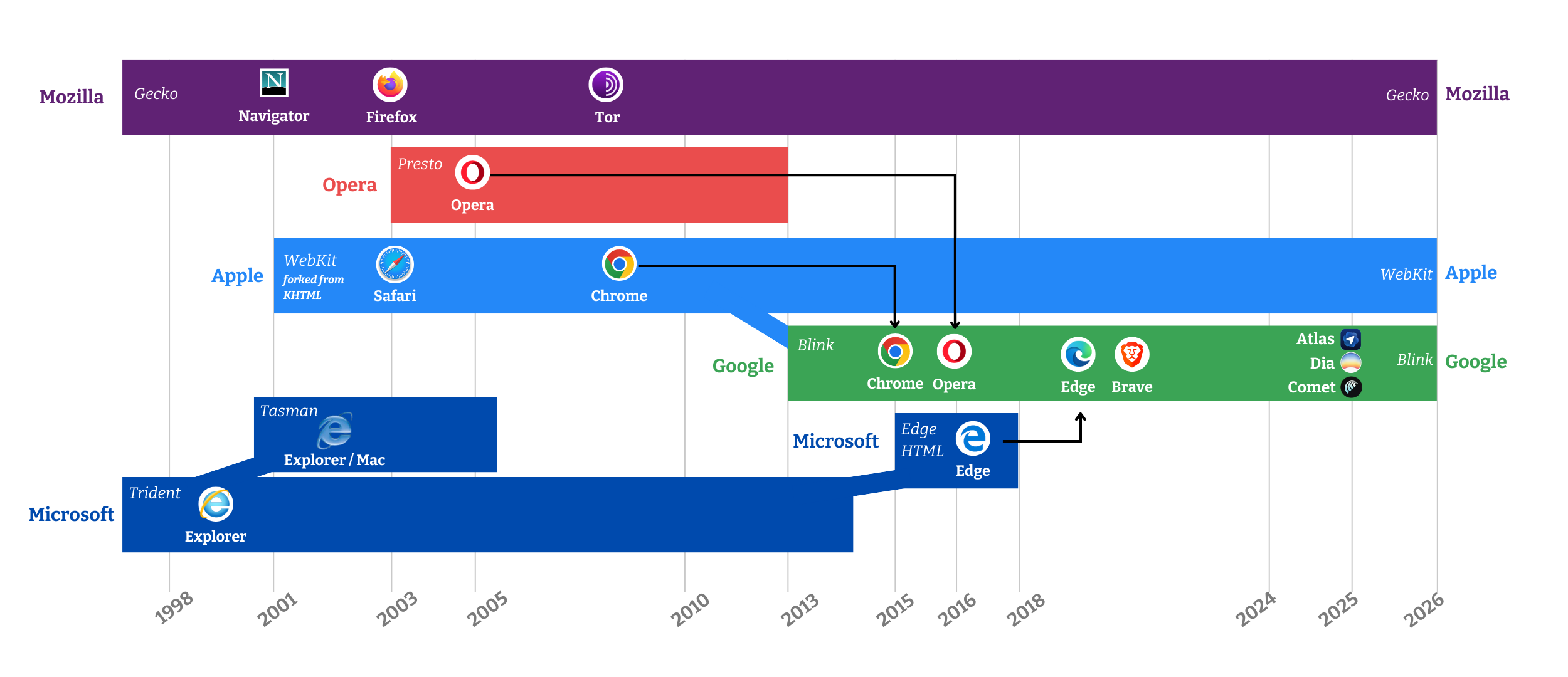
There are only three major browser engines left — Apple’s WebKit, Google’s Blink and Gecko from Mozilla. Apple’s WebKit mainly runs on Apple devices, making Gecko the only cross-platform challenger to Blink.
This concentration increasingly risks hard-coding a single company’s technical assumptions into the future of the web. Market pressures often turn standards-compliant but differing implementation choices into “bugs” that need fixing.
As both human and AI-driven browsing expand in use, choices about API implementation, data access, and security boundaries at the browser engine level become even more critical. A monoculture at the engine layer could extend to producing a monoculture in AI browsing experiences as well.
Maintaining an Independent Browser Engine Allows Mozilla to be More User-centric
Gecko, as an independent browser engine, tangibly allows Mozilla to build and operate in a way that is aligned with our mission: keeping the web open, secure, privacy-first, and accessible to everyone. It ensures that Mozilla is not only advocating for these principles but actively building the underlying infrastructure that makes them possible.
Through Gecko, we have the freedom to design and ship features based on what is best for users, rather than what is easiest or most profitable within another company’s technology stack.
In practice, this enables us to:
- Introduce privacy and security protections that go beyond industry defaults, such as strong cross-site tracking protections and anti-fingerprinting measures.
- Experiment with new user interface designs and customization options that give people more control over how they use the web.
- Build features that reflect Mozilla’s mission-driven priorities, even when they diverge from dominant commercial models.
If a small number of vertically integrated companies (AI assistants, search, operating systems, ads) completely control browser engines, then competition, transparency, and user choice on the open web will be much harder to achieve. They will have strong incentives to favour their own services, limit interoperability, and steer defaults and standards to their advantage.
Maintaining an independent engine also lowers barriers for others. Newer entrants to the browser space can rely on interoperability as defined in specifications. If they are not building their own engine, building on Gecko can help sustain a more competitive browser ecosystem. Engine diversity at this foundational layer enables innovation, which is shaped by multiple actors and multiple visions, rather than it being dictated by a single dominant platform.
Browser Engine Plurality Ensures Tech is Built For People, Not Shareholders
In an era defined by platform consolidation and AI-driven change, browser engines can’t be treated as invisible infrastructure. Independent engines like Gecko provide a structural counterbalance. Browser engine plurality is needed to ensure competition, transparency, and technology built for people, not shareholders.
As governments increasingly focus on security, resilience and sustainable growth, browser engine competition has a central role to play in avoiding single points of vulnerability or failure. Meaningful competition and a focus on open source approaches help ensure that economies are not locked into a single company’s infrastructure and that governments, companies, and people retain real choice over where to build and how to optimize for their needs.
Mozilla has long engaged with policymakers and regulators on the importance of competition and openness at the browser and engine layer. As the web and broader technology landscape continue to evolve, especially in the face of AI, we will continue to advance policies that protect engine diversity, promote fair competition, and ensure the web evolves in the public interest.