At Mozilla, we’ve long believed in giving people choice and agency over their experiences online. As power in digital markets has concentrated in a small number of large companies, there have been efforts in the US, Japan, UK, India, Korea, Brazil and elsewhere to restore competition and put choice back in people’s hands.
These efforts are at various stages, but first among them was the EU’s Digital Markets Act. Over two years since obligations came into effect, the DMA is delivering for people in some key areas.
Not everywhere. Not perfectly. And not without enforcement. But browser choice is the clearest example.
Every 10 seconds, someone picks Firefox through a DMA choice screen
Operating systems like iOS, Android, Windows, and MacOS lean on pre-installed browsers, tricky default settings, and deceptive design to make it hard for people to exercise choice and to keep independent browsers from competing on a level playing field. But where the DMA has created opportunities for genuine browser choice, people are taking it.
New Mozilla data is clear: since the rules took effect, Firefox is selected through a DMA browser choice screen every 10 seconds. That adds up to more than six million Firefox selections. And people are sticking with us: retention is five times higher when people choose Firefox through a choice screen.
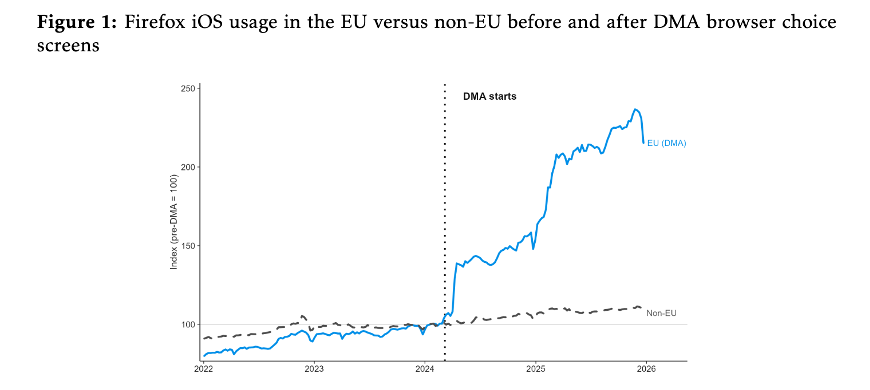
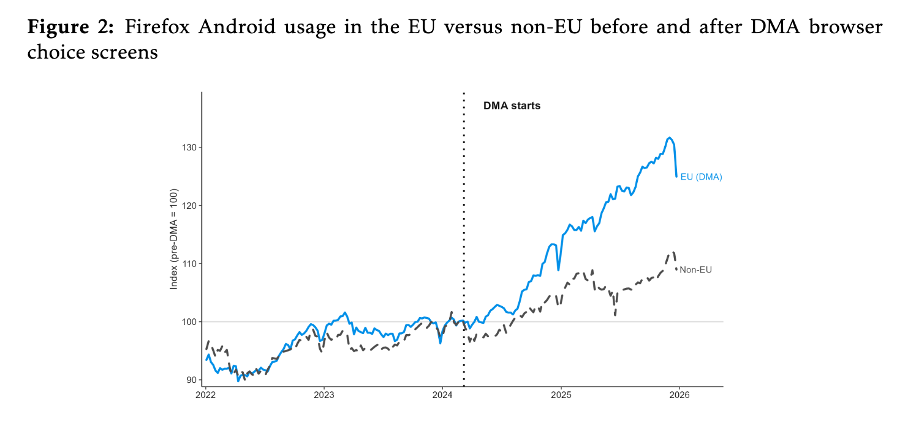
Academic analysis points the same way. Independent researchers compared Firefox daily active users in the EU with 43 non-EU countries. Comparing the 15 months before and after browser choice screens rolled out on iOS, they found that Firefox daily active users (DAU) were 113% higher in the EU than it would have been without the DMA. On Android, it was 12% higher. The smaller Android effect is due to the fact that Firefox usage there started from a much higher base, and the Android rollout has been more uneven than on iOS. The research also shows that the DMA’s effect is growing over time.
Browser choice on mobile is moving, but desktop is left behind
The DMA’s work isn’t done. There remains room for improvement on mobile (including making it easier to import your data to a new browser and switch with one click). However, desktop remains largely untouched – leaving roughly 310 million desktops and laptops in the EU without equivalent browser choice. For example, Windows users are subject to deceptive design tactics and are not given an active choice. Even where choice screens exist, they are not a silver bullet; ecosystem lock-in and interoperability barriers still hold back competition and innovation.
Still, the signal is clear: when people get real browser choice, they take it and select alternatives. It’s easy for gatekeepers to dismiss this as a couple of competitors benefiting. This ignores the range of challenger browsers also reporting huge growth in the EU. What’s more, it ignores the benefit to people. DMA browser choice screens are reaching different audiences. Mozilla analysis shows that women make up a significantly higher share of Firefox selections on iOS via a choice screen than organic downloads, suggesting that choice screens may successfully reach a demographic that reports lower confidence in manually changing browser defaults. The DMA’s effects are only starting to be felt and understood.
The road ahead
Effective enforcement of the obligations is the way forward. Gatekeepers continue to test and, in many instances, openly push back against the intent of the DMA provisions. This can take the form of implementation choices that limit real user uptake, delays in rolling out effective solutions, or sustained efforts to reinterpret, weaken, or roll back key provisions.
Most evidently, privacy and security arguments are often elevated in ways that risk diverting attention from whether compliance is delivering genuine choice and competition in practice. In reality, privacy, security, and effective competition can and should be designed to work hand-in-hand. They do not always have to be traded off.
Policymakers and enforcers should remain focused on outcomes: ensuring that the DMA delivers real-world competition and user choice, and resisting efforts to dilute its impact through partial compliance or narrative reframing.
Browser choice is just the start
Mozilla’s hope is that real browser choice will become the rule, rather than the exception. And that the lessons of browser choice screens will be applied to other areas of the DMA, including data portability and interoperability. Only with full compliance – including applying the existing DMA text to AI – can the full benefits of competition and innovation be brought to people in the EU.