Disruptions to internet connectivity can occur in countless ways – from weather incidents, natural disasters and accidents to intentional interferences like cyberattacks and government-issued blackouts. Yet while some disruptions are unavoidable, deliberate shutdowns represent a fundamentally different and deeply concerning trend. They undermine the open, global nature of the internet and put the safety, security, and fundamental rights of millions at risk.
For over 25 years, Mozilla has worked to ensure that the internet remains a global public resource—open, accessible, and safe for all. This vision, grounded in the Mozilla Manifesto, holds that the internet must remain a shared, decentralized infrastructure that empowers individuals, supports civic participation, and enables economic opportunity. Internet shutdowns run counter to these principles by restricting access, concentrating control, and weakening the very foundations of the open web.
To help organizations study and document outages, Mozilla makes aggregated Firefox telemetry data available to help identify and understand connectivity disruptions. As 2026 progresses, this data continues to show significant outages affecting millions of people worldwide—many of them the result of deliberate restrictions.
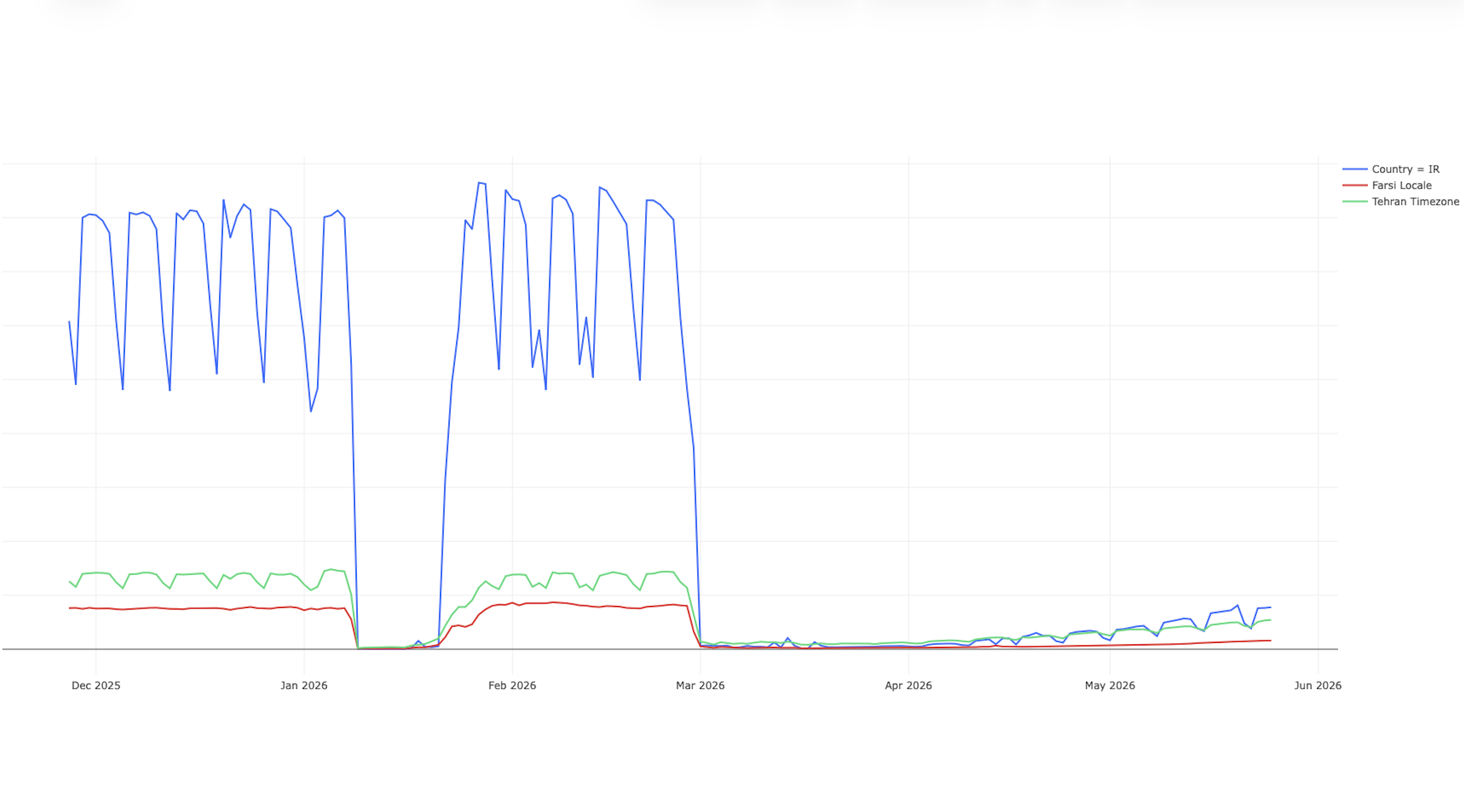
As of late May, Iran’s internet blackout had been in place for over 80 days, making it the longest shutdown since the Arab Spring. Following an earlier shutdown amid nationwide protests in January 2026, Iranian authorities have restricted access to the internet since 28 February. This has meant that, for almost three months, millions of Iranians have been cut off from news, communication, work, education, and basic services. It also means that almost no independent information about the situation in Iran is leaving the country, making it almost impossible for humanitarian organizations to assess the situation on the ground. The shutdown has also had a massive impact on the Iranian economy, severely disrupting financial activity and blocking international transactions. Although Iran’s president has recently ordered an end to the shutdown, it is unclear how and when Iranians will be able to reconnect to the web.
When large numbers of Firefox users experience connection failures for any reason, this produces an anomaly in the recorded telemetry data. At the country or city level, this can provide a corroborative signal of whether an outage or intentional shutdown occurred. Our telemetry documents the magnitude of the latest outage in Iran. The graph below documents the effect of the outage in multiple ways, such as users’ country location, language and timezone.
Across the globe, governments are increasingly interfering with and limiting access to connectivity. Both the number of states limiting connectivity and the amount of internet shutdowns has been growing steadily. In 2025 alone, 313 shutdowns across 52 countries have been documented, a sad record. This is a stark indication that shutdowns and restrictions are no longer a rare emergency measure, but established levers of control.
While the triggers for shutdowns are varied, access to the internet continues to be blocked especially often in times of conflict and political unrest. Especially in the context of hostilities, political tensions or public health emergencies, access to connectivity is a basic humanitarian need.
Beyond their immediate human impact, blackouts also affect the internet itself. Local networks depend on each other to form the global internet, and local restrictions affect the resilience and reliability of the web at large. When governments deliberately disrupt connectivity, they do not only isolate populations; they also contribute to the fragmentation of the global internet, undermining trust, interoperability, and the stability of shared infrastructure. Over time, this erosion risks replacing a single, open web with a patchwork of disconnected or controlled networks.
Governments should foster the health of the internet, not erode it. Access to the internet is widely recognized as essential for enjoying human rights. It is an integral part of modern life, facilitating education, communication, collaboration, business and entertainment. Preserving the open web requires sustained commitment: resisting shutdowns, promoting transparency, and reinforcing the technical and governance frameworks that keep the internet global, interoperable, and accessible. The internet’s value—as a platform for opportunity, innovation, and human connection—depends on it remaining open to all.