Categories
Firefox Google Chrome Memory allocation Memory consumption MemShrink

MemShrink progress, week 31

Lots of good stuff happened this week in MemShrink-land.

Necko Buffer Cache

I removed the Necko buffer cache.  This cache used nsRecyclingAllocator to delay the freeing of up to 24 short-lived 32KB chunks (24 x 16KB on Mobile/B2G) in the hope that they could be reused soon.  The cache would fill up very quickly and the chunks wouldn’t be freed unless zero re-allocations occurred for 15 minutes.  This idea is to avoid malloc/free churn, but the re-allocations weren’t that frequent, and heap allocators like jemalloc tend to handle cases like this pretty well, so performance wasn’t affected noticeably.  Removing the cache has the following additional benefits.

  • nsRecyclingAllocator added a clownshoe-ish extra word to each chunk, which meant that the 32KB (or 16KB) allocations were being rounded up by jemalloc to 36KB (or 20KB), resulting in 96KB (24 x 4KB) of wasted memory.
  • This cache wasn’t covered by memory reporters, so about:memory’s “heap-unclassified” number has dropped by 864KB (24 x 36KB) on desktop and 480KB (24 x 20KB) on mobile.

I also removed the one other use of nsRecyclingAllocator in libjar, for which this recycling behaviour also had no noticeable effect.  This meant I could then remove nsRecyclingAllocator itself.  Taras Glek summarized things nicely:  “I’m happy to see placebos go away”.

Other Stuff

I gave a talk at the linux.conf.au Browser MiniConf entitled “Notes on Reducing Firefox’s Memory Consumption”, which got some attention on Slashdot.

Henrik Skupin reported that Ghostery 2.6.2 and 2.7beta2 have memory leaks (zombie compartments).  I contacted the authors today and they said they are looking into the problem, so hopefully we’ll see a fix soon.

Gian-Carlo Pascutto reworked the code that downloads the safe browsing database to use less memory, and to have a fallback if memory runs out.  This memory usage is transient and so the main benefit is that it prevents some out-of-memory crashes that were happening frequently.

Last week I mentioned bug 703427, which held up the possibility of a simple, big reduction in SQLite memory usage.  Marco Bonardo did some analysis, and unfortunately the patch caused large increases in the number of disk accesses, and so it won’t work.  A shame.

Kyle Huey fixed a zombie compartment that occurred when right-clicking on a single-line textbox.  The fun thing about this was that in only 3 hours and 35 minutes, the following events happened: the bug report was filed, the problem was confirmed by two people, the bug report was re-categorized into the appropriate component, a patch was posted, the patch was reviewed, the patch landed on mozilla-central, and the bug report was marked as fixed!  And approval for back-porting to Aurora was granted 8 hours later.  Not bad.  Kyle has also made progress on a more frequent zombie compartment caused by searching for text.

Jonathan Kew made the shaped-word caches (which are involved in text rendering) discard their data on memory pressure events.

Quote of the week

A commenter on my blog named jas said (the full comment is here):

a year ago, FF’s memory usage was about 10x what chrome was using in respect to the sites we were running…

so we have switched to chrome…

i just tested FF 9.0.1 against chrome, and it actually is running better than chrome in the memory department, which is good. but, it’s not good enough to make us switch back (running maybe 20% better in terms of memory). a tenfold difference would warrant a switch. in our instance, it was too little, too late.

but glad you are making improvements.

So that’s good, I guess?

I also like this comment from the aforementioned Slashdot thread!

Bug Counts

Here are the current bug counts.

  • P1: 24 (-3/+1)
  • P2: 131 (-8/+7)
  • P3: 69 (-1/+3)
  • Unprioritized: 3 (-3/+2)

That’s a net drop of two, largely because I went through and closed some P1 and P2 bugs that were stale or had been fixed elsewhere.
Categories
about:memory AdBlock Plus add-ons compartments DMD Firefox Garbage Collection JägerMonkey Massif Memory allocation Memory consumption MemShrink Performance SQLite Talks Valgrind

Notes on Reducing Firefox’s Memory Consumption

I gave a talk yesterday at the linux.conf.au Browser MiniConf, held in Ballarat, Australia.  Its title was “Notes On Reducing Firefox’s Memory Consumption”.

Below are the slides and notes in a SlideShare embedding. If you find that embedding problematic (some people do) you may prefer to download the PDF version directly.

Categories
about:memory AdBlock Plus add-ons compartments Firefox Memory consumption MemShrink

MemShrink progress, week 30

Add-ons

This was the week of add-ons in MemShrink-land.

Jared Wein fixed a problem in Firefox that was causing zombie compartments if you viewed a native video with any add-on installed that implements the nsIContentPolicy interface.  Examples of such add-ons are Adblock Plus, GreaseMonkey, and NoScript, which are respectively the #1, #3 and #9 most popular add-ons on AMO!  Welcome to the MemShrink club, Jared.

Speaking of GreaseMonkey, Arantius fixed a bug in it that was causing zombie compartments on some GM scripts when opening a background tabs.

I can’t tell who was responsible for the next fix, because the Add-on SDK folks use Github in a way I don’t understand.   But Myk Melez and/or Gabor Krizsanits greatly reduced the number of compartments used in JetPack-style add-ons.  In one example, the number of compartments dropped from 156 to 8, saving about 20MB of memory.  This was a MemShrink:P1 bug.

Also, as far as I can tell, the same patch also fixed bug 680821 which means that all compartments that hold sandboxes created by JetPack-style add-ons will be marked as belonging to that add-on in about:memory.

Jordan Miner reported that the Delicious Bookmarks add-on is leaking excessive numbers of connections to the Places database.  I tried to reproduce the problem and failed, but I don’t have a Delicious account.  If anyone else who does have a Delicious account is able to reproduce, please let me know or comment in the bug.

Finally, Jorge Villalobos and Andrew Williamson from the add-ons team came to this week’s MemShrink meeting.  We had a very fruitful discussion about how to help add-on authors detect and avoid memory leaks, and how to help add-on users understand which add-ons have high memory consumption.  Stay tuned for more details in the coming weeks!

Three Cheers for New Contributors

Krzysztof Kotlenga, a new contributor, removed an OpenGL cache that was wasting 1GB+ of memory on Linux when hardware acceleration was enabled (it’s currently not enabled by default, but will be at some point in the future).   Great work, Krzysztof!  [Update: I originally wrote WebGL instead of OpenGL, which was incorrect.]

Bug Counts

Here are the current bug counts.

  • P1: 26 (-2/+0)
  • P2: 132 (-14/+3)
  • P3: 67 (-2/+5)
  • Unprioritized: 4 (-0/+4)

That’s a net reduction of six bugs.  The main factor here was that I went through some of our P2s and closed ones that were stale and/or covered by other bugs, and downgraded to P3 a few more that are now known to be less important than we first thought.

Before finishing, I’d like to highlight bug 703427.  Richard Hipp, one of the SQLite developers, has a tiny patch that drastically reduces the amount of memory used by SQLite in Firefox — I ran with it for a while and my SQLite memory consumption dropped from ~15MB to less than 3MB.  The patch also causes a moderate speed drop, but it’s unclear if that speed drop is noticeable to Firefox.  We need someone who understands Firefox’s SQLite usage well to evaluate this patch so that Richard knows if it’s something that should go into a released version of SQLite as an option.  The bug is assigned to Marco Bonardo but he’s currently very busy.  Is there anyway else who knows enough about SQLite to take on this bug?

Categories
Build system Firefox

A fix for an 11-year-old bug in the build system

I have noticed for months that when building Firefox, sometimes configure will run when it shouldn’t, e.g. when I haven’t changed any makefiles or other build system files.  This is annoying, because it increases the time taken for a complete no-change build on my Linux box from ~50 seconds to ~70 seconds.  And it happens reasonable frequently, but I haven’t been able to reproduce it reliably.

Until yesterday, that is! I realized it happened reliably if I alternated building two different objdirs (e.g. debug and opt).  Once I could reproduce it reliably, it wasn’t hard to use make’s -d option to find out what was causing configure to re-run.  The answer was a file called $(topsrcdir)/.mozconfig.mk.  Because it is put in $(topsrcdir) instead of $(objdir), the building of one objdir can affect the building of another objdir.

The fix was pretty easy — it’s hard to move .mozconfig.mk out of $(topsrcdir), but there’s no good reason to re-run configure every time it changes, because it doesn’t contain anything that affects configure. So it was a one-line change in clienk.mk.

Kyle Huey tells me this bug has been present since 2000!

Categories
add-ons Firefox MemShrink

MemShrink progress, weeks 28–29

It’s been a quiet couple of weeks, due to Christmas, New Year, and all that.

Two leaks in add-ons were fixed.

  • cyberscorpio fixed a zombie compartment in the Super Start add-on.  The problem was that the add-on was failing to remove an event observer when a page is unloaded.  The fix will be present in v3.6.2.
  • Jesse Hakanen fixed a zombie compartment in the AdBlock Plus Pop-up Addon add-on (note that this is add-on extends the blocking functionality of AdBlock Plus, it’s not AdBlock Plus itself).  The problem was that the add-on was failing to catch the page unload event, and so some references to closed pages were left in memory.  The fix is now available in v0.3.

Because both leaks had similar causes, I updated the documentation on avoiding zombie compartments in add-ons accordingly.

Patches for two other MemShrink bugs landed.

I saw two noteworthy mentions of Firefox’s recent reductions in memory consumption. The first was in webmonkey.com’s review of Firefox 9.

Alongside the faster JavaScript processing Firefox 9 continues to show improvements from Mozilla’s MemShrink project, an ongoing effort to reduce memory usage in the browser. Indeed, for the first time in a very long time my testing showed Firefox 9 using less memory than Opera (which has long been the least RAM-hungry browser I test). Opening the same dozen tabs in both Firefox and Opera used only 367MB of RAM in Firefox compared to 378MB in Opera 11.60 [Update: Note that the memory test was performed with the following Firefox add-ons running: AdBlock, Ghostery, BetterPrivacy and HTTPS-Everywhere.] There’s no longer much difference between the two, which is a testament to Firefox’s dramatic improvement over the last six months of MemShrink efforts.

Cross-browser memory comparisons are fraught with difficulties, both in the measuring and the interpreting, so I don’t give the comparison with Opera much weight.  But the fact that this author has seen Firefox’s own memory consumption drop over the last few versions is meaningful.

The second was a comment on the previous MemShrink progress report from AC about Firefox 10.

You may remember that I posted a few weeks ago saying that Firefox 9 beta was great and that I could definitely see more memory and performance improvements over Fire 7 and 8. Well I am pleased to say that after a few days of using Firefox 10 beta 1, I can clearly see more memory improvements again. There is an obvious difference between Firefox 9 and Firefox 10 on the beta channel.

I have no hard evidence as such other than saying that nothing has changed on my laptop in the last few weeks but I am using the same heavy tab load and the memory usage displayed by Windows task manager is lower than it was by about 20 MB and the responsiveness and speed feels sharp.

Whatever you guys are doing with the Memshrink project, keep doing it because the results are paying dividends.

I’ve read literally 1000s of complaints about Firefox’s memory consumption online, so it’s very encouraging to hear compliments.

Here are the current bug counts.

  • P1: 28 (-0/+2)
  • P2: 143 (-1/+5)
  • P3: 64 (-1/+1)
  • Unprioritized: 0 (-0/+0)

No big changes, unsurprisingly.  [Update: the P2 numbers were incorrect and have been fixed.]

Categories
about:memory AdBlock Plus Firefox Memory consumption MemShrink

MemShrink progress, week 27

Adaptive Memory Behaviour

The biggest news this week was that Justin Lebar landed code to make Firefox’s memory consumption adaptive on Windows.  The code works by wrapping VirtualAlloc() and some similar OS-level allocation functions.  Each time memory is allocated, the amount of available virtual and physical memory is measured by the wrapper.  If either of those amounts are below a threshold, a memory pressure event is triggered, which causes numerous components within Firefox to take steps to reduce their memory consumption.

It might not sound like it, but this is a big deal, and it was a MemShrink:P1 bug.  Firefox runs on a huge variety of machines and devices, and trying to find one-size-fits-all heuristics for discarding regenerable data is a recipe for unhappiness somewhere.  Adaptive behaviour is much better.

The initial settings for this feature are conservative, and some tuning may be needed.

  • The threshold used for virtual memory is 128MB, i.e. if the amount of available virtual memory drops below 128MB a memory pressure event is triggered.  (This number can be changed in about:config via the “memory.low_virtual_memory_threshold_mb” setting.) Hopefully this will reduce the number of OOM crashes that occur on Windows.
  • The threshold used for physical memory is 0, which means that it is currently ignored.  (This number can be changed in about:config via the “memory.low_physical_mem_threshold_mb” setting.) The reason for ignoring it currently is that low physical memory may be caused by a program other than Firefox — we don’t want to start discarding data if Firefox is only using a small fraction of physical memory.  In the future we can probably do better here by triggering memory pressure events if the fraction of physical memory used by Firefox exceeds some threshold;  hopefully this will avoid paging when memory usage is high.
  • Memory pressure events are throttled so they aren’t sent more than once every 10 seconds.  (This number can be changed in about:config via the “memory.low_physical_memory_notification_interval_ms” setting.)  This prevents thrashing in cases where the memory pressure events don’t help reduce memory consumption.

Memory pressure events are also currently unevenly observed — plenty of data could be dropped that currently isn’t — so there is room for improvement there.

Finally, there’s another bug still open to add similar adaptive behaviour on Mac, Linux and Android.  Note also that memory pressure events are also triggered on Android when Firefox goes into the background.

Add-ons

There has been good news for add-ons:  the #1, #6 and #8 most popular add-ons on AMO have all recently seen some MemShrink-related improvements.

Adding memory reporters to add-ons is a really good thing to do, and I plan to write some documentation to encourage other add-on developers to follow suit.  However, if you are an add-on developer and are thinking of doing this, I need to stress one thing:  the reports must have KIND_OTHER so that they end up in the “Other Measurements” list in about:memory.  If they are put in the “explicit” tree, then some memory bytes may be counted twice (once by Firefox, once by the add-on) which will completely screw up about:memory’s results.

Memory Reporters

I landed several improvements to memory reporters.

Bug Counts

Here are the current bug counts.

  • P1: 26 (-2/+1)
  • P2: 139 (-6/+6)
  • P3: 64 (-2/+2)
  • Unprioritized: 0 (-1/+0)

Nice to see the total count drop, even if only by one.

Due to the Christmas break there won’t be a MemShrink meeting nor a MemShrink progress report next week.  I’ll be back in two weeks, enjoy the break!

Categories
about:memory Firefox Memory consumption MemShrink

MemShrink progress, week 26

It’s been six months since MemShrink started!  Here are this week’s events of note.

Memory Reporting

I integrated DMD support into Firefox.  This is a big deal because DMD is crucial for improving the coverage and correctness of memory reporters.  There are several consequences of this.

  • You no longer need to apply a patch to Firefox if you want to use DMD, you just have to configure with --enable-dmd.  (Full instructions are here.)
  • Any memory reporter written in the new style (i.e. using a nsMallocSizeOfFun function created with NS_MEMORY_REPORTER_MALLOC_SIZEOF_FUN) will automatically get coverage in DMD.
  • DMD finds bugs in memory reporters, but it can also find bugs elsewhere.  For example, this week it found that some BaseShapes were being shared incorrectly, which Brian Hackett fixed.

I updated the layout memory reporters to use the new style.  I also updated the documentation on writing memory reporters, to cover more complicated topics like how to measure classes that involve inheritance.  I also added a request:  if you write a memory reporter, please add me as a co-reviewer.

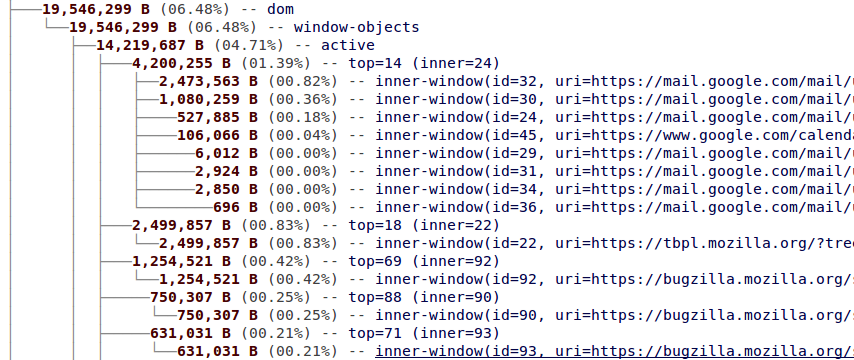
Johnny Stenback implemented per-window DOM memory reporters, which gives much more detail for DOM memory usage in about:memory.  Here’s an example:

per-window dom reporter output in about:memory

Memory Usage Improvements

Boris Zbarsky lazily initialized some rulehash tables, saving about 45KB per blank tab;  this is a nice win for those people who have on-demand tab loading combined with sessions with many tabs.  The same patch also made one of the rulehash tables smaller when it is initialized, which can cause multi-MB savings on workloads of only a few tabs.

Bobby Holley fixed a bad memory leak in xpconnect that could cause unbounded amounts of memory to be leaked, albeit in somewhat unusual circumstances.  The bug was only in Firefox 9 and Firefox 10;  it’s been fixed for 10, and the patches to fix for 9 are ready to land.

Fabrice Desré fixed a regression that caused a zombie compartment when visiting addons.mozilla.org.

Bug Counts

Here are the current bug counts.

  • P1: 27 (-1/+1)
  • P2: 139 (-5/+3)
  • P3: 62 (-0/+2)
  • Unprioritized: 1 (-0/+1)

That’s a net change of +1, and we only had to triage seven bugs in today’s meeting.  And if the trees hadn’t been closed for the past few days I could have fixed two more P2 bugs.

Just for fun, I also counted the number of RESOLVED FIXED (i.e. genuine, not duplicates or invalid) MemShrink bugs.

  • P1: 29
  • P2: 70
  • P3: 14
  • Unprioritized: 35

(If you’re wondering why the number of unprioritized fixed bugs is so high, it’s because MemShrink bugs are only prioritized in MemShrink meetings, which means that any bug that gets filed and fixed in less than 7 days doesn’t get prioritized.)

So there are more bugs still open than have been fixed, but the rate of bug growth is close to zero.

Categories
about:memory Firefox Memory consumption MemShrink

MemShrink progress, week 25

It was a good week for MemShrink.

ObjShrink

The biggest news this week is that Brian Hackett landed his objshrink work.  This has roughly halved the size of Firefox’s representation of JavaScript objects.  It’s also reduced the amount of memory Firefox uses for shapes, a related data structure.  If  you look at about:memory you can see that “gc-heap/objects” and “gc-heap/shapes” entries account for many MBs of memory, so this is a big win.  Read here (under the “Objects” and “Shape” headings) if you want more details.

Memory Reporting

I added some more JavaScript memory reporters and fixed some problems with the existing ones.  Specifically…

  • New: “runtime/threads/temporary” counts various pieces of short-lived data, mostly parse nodes.  It sometimes spikes up to multiple MBs.
  • New: “runtime/threads/normal” measures thread data on the heap that isn’t covered by “runtime/threads/temporary”.  It’s normally a few 100s of KBs.
  • New: “runtime/contexts” measures JSContexts and various related structures, which usually account for a few 10s or 100s of KB.
  • New/fixed: “runtime/threads/regexp-code” measures code generated by the regexp compiler.  This was previously measured under “mjit-code/regexp” but that reporter was broken recently when the location of this generated code was moved, so I fixed it.
  • Fixed: “runtime/atoms-table” and “runtime/runtime-object” are existing reporters that together often account for up to 4.5MB.  They were incorrectly marked as measuring non-heap memory instead of heap memory, meaning that the “explicit” and “heap-unclassified” totals were both incorrectly inflated by that amount.  While fixing this, I also confirmed that we weren’t making the same mistake with any of our other memory reporters.
  • Renamed: “runtime/threads/stack-committed” was previously called “stack-size”.  I renamed it to go with the other “runtime/threads” reports because that’s where it conceptually belongs.

I also added a memory reporter for XPConnect.  It typically accounts for 1MB or more.

I have a lot more work in the pipeline to improve the coverage and correctness of memory reporters.  More about this in the coming weeks as I land the relevant patches!

Other

Joel Maher got RSS memory measurements working for Android on Talos, Mozilla’s performance regression testing suite.  This was a MemShrink:P1 bug.  Graphs of the live data can be seen here.

Benoit Jacob made some improvements how Firefox manages and reports memory used by WebGL.

Bug Counts

Here’s the current bug count.

  • P1: 27 (-1/+1)
  • P2: 141 (-3/+5)
  • P3: 62 (-1/+2)
  • Unprioritized: 0 (-0/+0)

Only three more MemShrink bugs than this time last week!  Pretty good.

Categories
about:memory Firefox Memory consumption MemShrink

MemShrink progress report, week 22

This was a quieter week.

Andrew McCreight finished his static analysis to detect cycle collector leaks.  See the details in the bug (and talk to Andrew) if you are interested in using this analysis.

I shrunk the size of js::HashTable by 4 bytes on 32-bit platforms and 8 bytes on 64-bit platforms.  This saves a few 10s or 100s of KB on typical workloads.

Marco Bonardo decreased the default maximum page size of SQLite connections, which can reduce SQLite memory usage somewhat.

Olli Pettay avoided some wasted space in one of the cycle collector’s data structures.  The cycle collector uses lots of memory but for a short time when it runs;  this change will reduce the size of this memory spike.

Gian-Carlo Pascutto added a memory reporter for one of the data structures used by the url-classifier.  This shows up in about:memory under “explicit/storage/prefixset” and is often over 1MB.

Justin Lebar improved the measurement of nsTArray’s memory usage, which will reduce the size of “heap-unclassified” in about:memory by a small amount.

Justin also wrote a good blog post about the challenges of addressing leaks in add-ons.

We only had seven new MemShrink bugs to triage in today’s meeting;  I’m pretty sure that is the fewest we’ve ever had.  Here are the current bug counts.

  • P1: 29 (+1/-1)
  • P2: 127 (-2/+3)
  • P3: 58 (-3/+2)
  • Unprioritized: 0 (-0/+0)

These counts are notable because the total number (214) is the same as last week!  Maybe the number will start dropping soon.

One thing worth pointing out about the +/- numbers is that if a bug is opened and closed between my weekly reports, it does not get counted in the +/- numbers.  In a way this is good, because it means that duplicate bugs and invalid bugs don’t affect the numbers.  But it also fails to capture bugs that were reported and fixed quickly.  (I usually describe such bugs in my posts, however.)

Categories
about:memory Firefox Garbage Collection Memory consumption MemShrink SQLite

MemShrink progress, week 21

MemShrink:P1 Bugs fixed

Terrence Cole made a change that allows unused arenas in the JS heap to be decommitted, which means they more or less don’t cost anything.  This helps reduce the cost of JS heap fragmentation, which is a good short-term step while we are waiting for a compacting garbage collector to be implemented.  Terrence followed it up by making the JS garbage collector do more aggressive collections when many decommitted arenas are present.

Justin Lebar enabled jemalloc on MacOS 10.7.  This means that jemalloc is finally used on all supported versions of our major OSes: Windows, Mac, Linux and Android.  Having a common heap allocator across these platforms is great for consistency of testing and behaviour, and makes future improvements involving jemalloc easier.

Gabor Krizsanits created a new API in the add-on SDK that allows multiple sandboxes to be put into the same JS compartment.

Other Bugs Fixed

I registered jemalloc with SQLite’s pluggable allocator interface.  This had two benefits.  First, it means that SQLite no longer needs to store the size of each allocation next to the allocation itself, avoiding some clownshoes allocations that wasted space.  This reduces SQLite’s total memory usage by a few percent.  Second, it makes the SQLite numbers in about:memory 100% accurate;  previously SQLite was under-reporting its memory usage, sometimes significantly.

Relatedly, Marco Bonardo made three changes (here, here and here) that reduce the amount of memory used by the Places database.

Peter Van der Beken fixed a cycle collector leak.

I tweaked the JavaScript type inference memory reporters to provide better coverage.

Jiten increased the amount of stuff that is released on memory pressure events, which are triggered when Firefox on Android moves to the background.

Finally, I created a meta-bug for tracking add-ons that are known to have memory leaks.

Bug Counts

I accidentally deleted my record of the live bugs from last week, so I don’t have the +/- numbers for each priority this week.

  • P1: 29 (last week: 35)
  • P2: 126 (last week: 116)
  • P3: 59 (last week: 55)
  • Unprioritized: 0 (last week: 5)

The P1 result was great this week — six fewer than last week.  Three of those were fixed, and three of those I downgraded to P2 because they’d been partially  addressed.

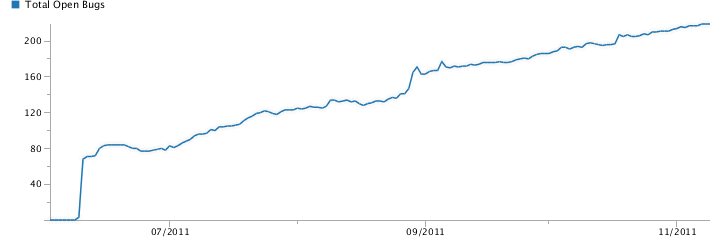
For a longer view of things, here is a graph showing the MemShrink bug count since the project started in early June.

memshrink bug count

There was an early spike as many existing bugs were tagged with “MemShrink”, and a smaller spike in the middle when Marco Castellucio tagged a big pile of older bugs.  Other than that, the count has marched steadily upward at the rate of about six per week.  Many bugs are being fixed and definite improvements are being made, but this upward trend has been concerning me.

Future Directions

So in today’s MemShrink meeting we spent some time discussing future directions of MemShrink.  Should we continue as is?  Should we change our focus, e.g. by concentrating more on mobile, or setting some specific targets?

The discussion was long and wide-ranging and not easy to summarize.  One topic was “what is the purpose of MemShrink?”  The point being that memory usage is really a secondary measure.  By and large, people don’t really care how many MB of memory Firefox is using;  they care how responsive it is, and it’s just assumed that reducing memory usage will help with that.  With that in mind, I’ll attempt to paraphrase and extrapolate some goals (apologies if I’ve misrepresented people’s opinions).

  • On 64-bit desktop, the primary goal is that Firefox’s performance should not degrade after using it heavily (e.g. many tabs) for a long time.  This means it shouldn’t page excessively, and that operations like garbage collection and cycle collection shouldn’t get slower and slower.
  • On mobile, the primary goal probably is to reduce actual memory usage.  This is because usage on mobile tends to be lighter (e.g. not many tabs) so the longer term issues are less important.  However, Firefox will typically be killed by the OS if it takes up too much memory.
  • On 32-bit desktop, both goals are relevant.

As for how these goals would change our process, it’s not entirely clear.  For desktop, it would be great to have a benchmark that simulates a lot of browsing (opening and closing many sites and interacting with them in non-trivial ways).  At the end we could measure various things, such a memory usage, garbage and cycle collection time, and we could set targets to reduce those.  For mobile, the current MemShrink process probably doesn’t need to change that much, though more profiling on mobile devices would be good.

Personally, I’ve been spreading myself thinly over a lot of MemShrink bugs.  In particular, I try to push them along and not let them stall by doing things like trying to reproduce them, asking questions, etc.  I’ve been feeling lately like it would be a better use of my time to do less of that and instead dig deeply into a particular area.  I thought about working on making JS script compilation lazy, but now I’ve decided instead to focus primarily on improving the measurements in about:memory, in particular, reducing the size of “heap-unclassified” by improving existing memory reporters and adding new ones. I’ve decided this because it’s an area where I have expertise, clear ideas on how to make progress, and tools to help me.  Plus it’s important;  we can’t make improvements without measurements, and about:memory is the best memory measurement tool we have.  Hopefully other people agree that this is important to work on 🙂