About You
My name is Andika. I’m from Indonesia, and I speak Indonesian, Javanese, and English. I’ve been contributing to Mozilla localization for a long time, long enough that I don’t clearly remember when I started. I mainly focus on Firefox and Thunderbird, but I also contribute to many other open source projects.

Exploring Padar Island where Komodo dragons can be spotted.
Contributing to Mozilla Localization
Q: Can you tell us a bit about your background and how you found localization?
A: I started my open source journey in the 1990s. Early on, I helped others through mailing lists by troubleshooting problems and answering questions. I also tried filing bugs and maintaining packages, but over time I felt those contributions didn’t always have a lasting impact.
Around 2005, I started translating open source software. Translation felt different — it felt like a contribution that could last longer than the technology itself. When I saw poor translation quality online, I felt I could do better, and that motivated me to get involved. Localization became the most meaningful way for me to give back.
Q: What does your contribution to Mozilla localization look like today?
A: I primarily work on Firefox and Thunderbird. Over the years, I’ve translated tens of thousands of strings although some of those strings no longer exist in the codebase and remain only in translation memory. I also contribute to many other open source organizations, but Mozilla remains one of my main areas of focus.
Even though I don’t always use the products I localize — my professional work involves backend work, a lot of remote troubleshooting and maintenance — I stay connected to the quality of the translations through community collaboration and shared practices.
Workflow, Habits, and Collaboration
Q: How do you approach your localization work and collaborate with others?
A: Most of my localization work happens incrementally. I often carry unfinished translation files on my laptop so I can continue working offline, especially when the internet connection isn’t reliable. When I have multiple modules to choose from, I usually start with the ones that have the fewest untranslated strings. Seeing a module reach full translation gives me a lot of satisfaction.
To avoid burnout, I set small, realistic goals, sometimes something as simple as translating 50 strings before switching to another task. I tend to use small pockets of free time throughout the day, like waiting at a public transportation station or an appointment, and those fragments add up.
Collaboration plays a big role in maintaining quality. Within the Indonesian localization community, we use Telegram to discuss difficult or new terms and work toward consensus. Terminology and style guides are maintained together; it’s not a one-person responsibility.
I’ve also worked on localization in other projects like GNOME, where we translate module by module, we review each other’s work, and then commit changes as a group. Compared to Pontoon’s string-by-string approach, this workflow offers more flexibility, especially when working offline.
Perspective Across Open Source and Beyond
Q: You contribute to many open source projects. How does Mozilla localization compare, and what would you like to see improved?
A: For Indonesian localization, Mozilla is the most organized team I’ve worked with and has the largest active team. Some projects may appear larger on paper, but active participation matters more than numbers, and that’s where Mozilla really stands out.
One improvement I’d like to see is better support for offline translation in Pontoon. Another area is shortcut conflict detection — translators often can’t easily see whether keyboard shortcuts conflict unless all menu items or dialog elements are rendered together. Automated checks or rendered views of translated dialogs would make that process much easier.
That said, one thing Pontoon does very well, and that other projects could learn from, is the improving quality of online and AI-assisted translation suggestions.
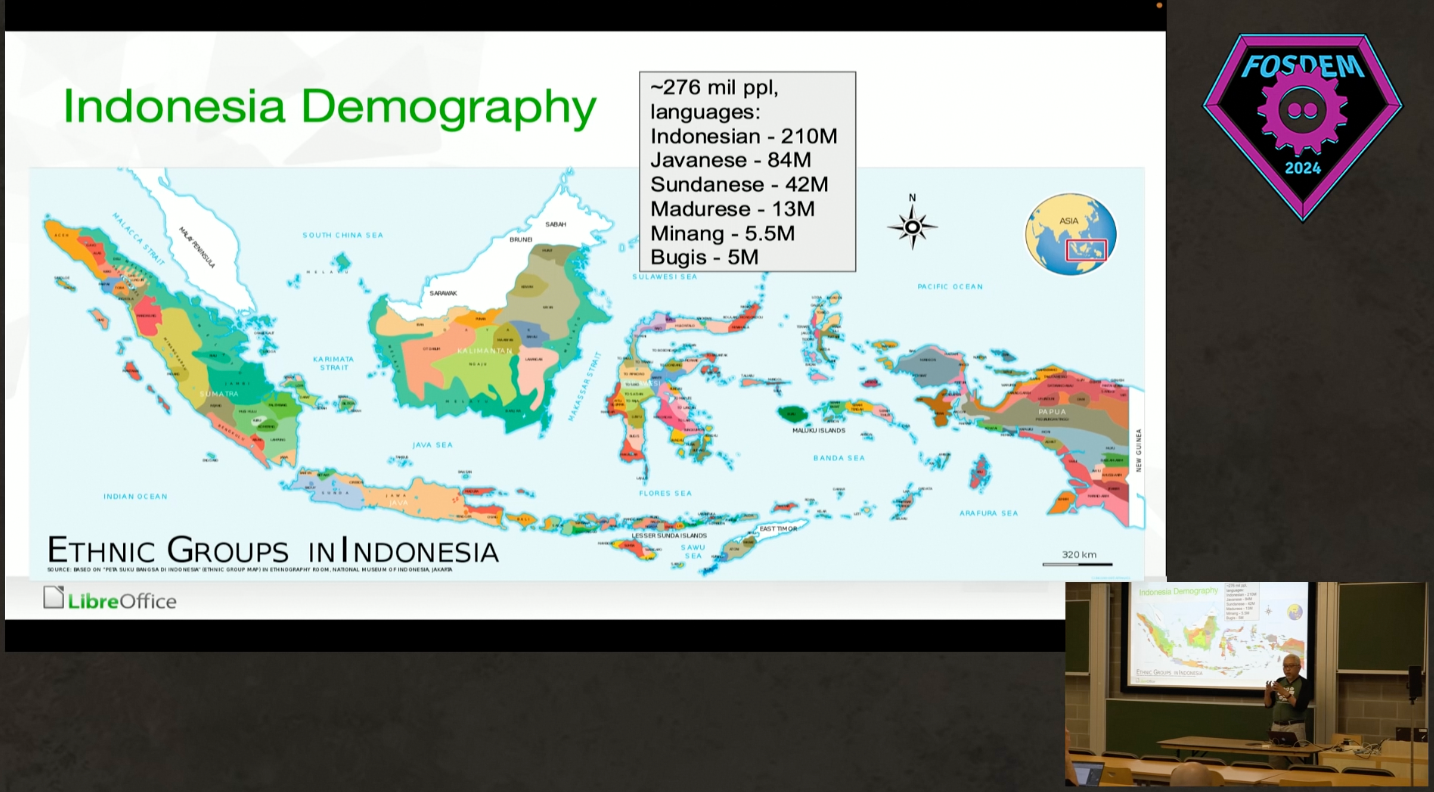
Speaking at Fosdem in February 2024 on “Long Term Effort to Keep Translations Up-To-Date”
Professional Life and a Personal Note
Q: What do you do professionally, and how does it connect with your localization work?
A: I work as an IT security consultant. I started using a PC in 1984, learning to program in BASIC, Pascal, FORTRAN, Assembly, and C. C is my most favorite language up to now. I also tried various OSes from CP/M, DOS, OS/2, VMS, Netware, Windows, SCO, Solaris, then fell in love with Linux. I have been using Debian since version 1.3. Later I changed my focus from programming into IT security. My job requires staying up to date with security concepts and terminology, which helps when translating security-related strings. At the same time, localization sometimes introduces me to features I might later use professionally. The two areas complement each other in unexpected ways.
As for something more personal: I hate horror movies, I love cats, and I’ve had the chance to witness the rise and fall of many technologies over the years. I also maintain a personal wiki to keep track of my open source work though I keep telling myself I need to migrate it to GitHub one day.
No comments yet
Post a comment