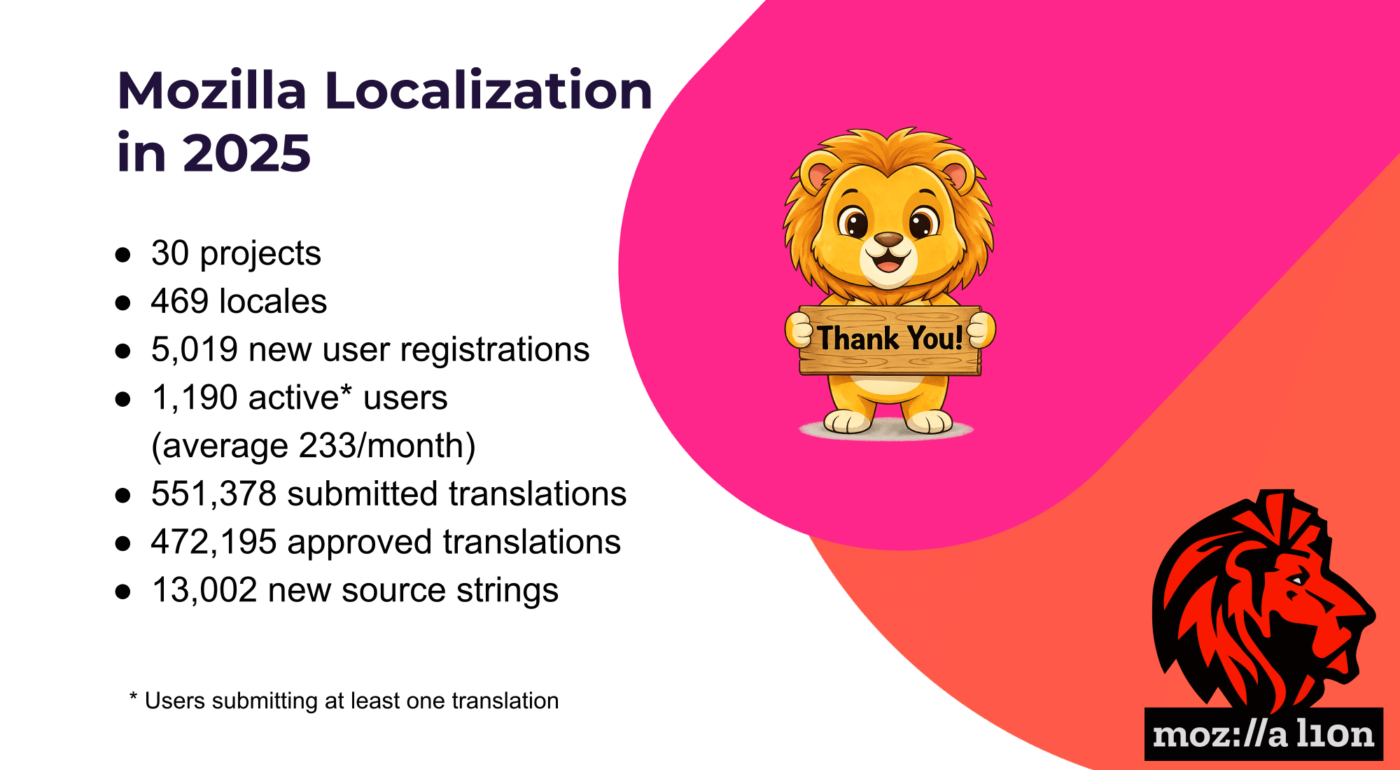
A Year in Data
As is tradition, we’re wrapping up 2025 for Mozilla’s localization efforts and offering a sneak peek at what’s in store for 2026 (you can find last year’s blog post here).
Pontoon’s metrics in 2025 show a stable picture for both new sign-ups and monthly active users. While we always hope to see signs of strong growth, this flat trend is a positive achievement when viewed against the challenges surrounding community involvement in Open Source, even beyond Mozilla. Thank you to everyone actively participating on Pontoon, Matrix, and elsewhere for making Mozilla localization such an open and welcoming community.
- 30 projects and 469 locales (+100 compared to 2024) set up in Pontoon.
- 5,019 new user registrations
- 1,190 active users, submitting at least one translation, on average 233 users per month (+5% Year-over-Year)
- 551,378 submitted translations (+18% YoY)
- 472,195 approved translations (+22% YoY)
- 13,002 new strings to translate (-38% YoY).
The number of strings added has decreased significantly overall, but not for Firefox, where the number of new strings was 60% higher than in 2024 (check out the increase of Fluent strings alone). That is not surprising, given the amount of new features (selectable profiles, unified trust panel, backup) and the upcoming settings redesign.
As in 2024, the relentless growth in the number of locales is driven by Common Voice, which now has 422 locales enabled in Pontoon (+33%).
Before we move forward, thank you to all the volunteers who contributed their time, passion, and expertise to Mozilla’s localization over the last 12 months — or plan to do so in 2026. There is always space for new contributors!
Pontoon Development
A significant part of the work on Pontoon in 2025 isn’t immediately visible to users, but it lays the groundwork for improvements that will start showing up in 2026.
One of the biggest efforts was switching to a new data model to represent all strings across all supported formats. Pontoon currently needs to handle around ten different formats, as transparently as possible for localizers, and this change is a step to reduce complexity and technical debt. As a concrete outcome, we can now support proper pluralization in Android projects, and we landed the first string using this model in Firefox 146. This removes long-standing UX limitations (no more Bookmarks saved: %1$s instead of %1$s bookmarks saved) and allows languages to provide more natural-sounding translations.
In parallel, we continued investing in a unified localization library, moz-l10n, with the goal of having a centralized, well-maintained place to handle parsing and serialization across formats in both JavaScript and Python. This work is essential to keep Pontoon maintainable as we add support for new technologies and workflows.
Pontoon as a project remains very active. In 2025 alone, Pontoon saw more than 200 commits from over 20 contributors, not including work happening in external libraries such as moz-l10n.
Finally, we’ve been improving API support, another area that is largely invisible to end users. We moved away from GraphQL and migrated to Django REST, and we’re actively working toward feature parity with Transvision to better support automation and integrations.
Community
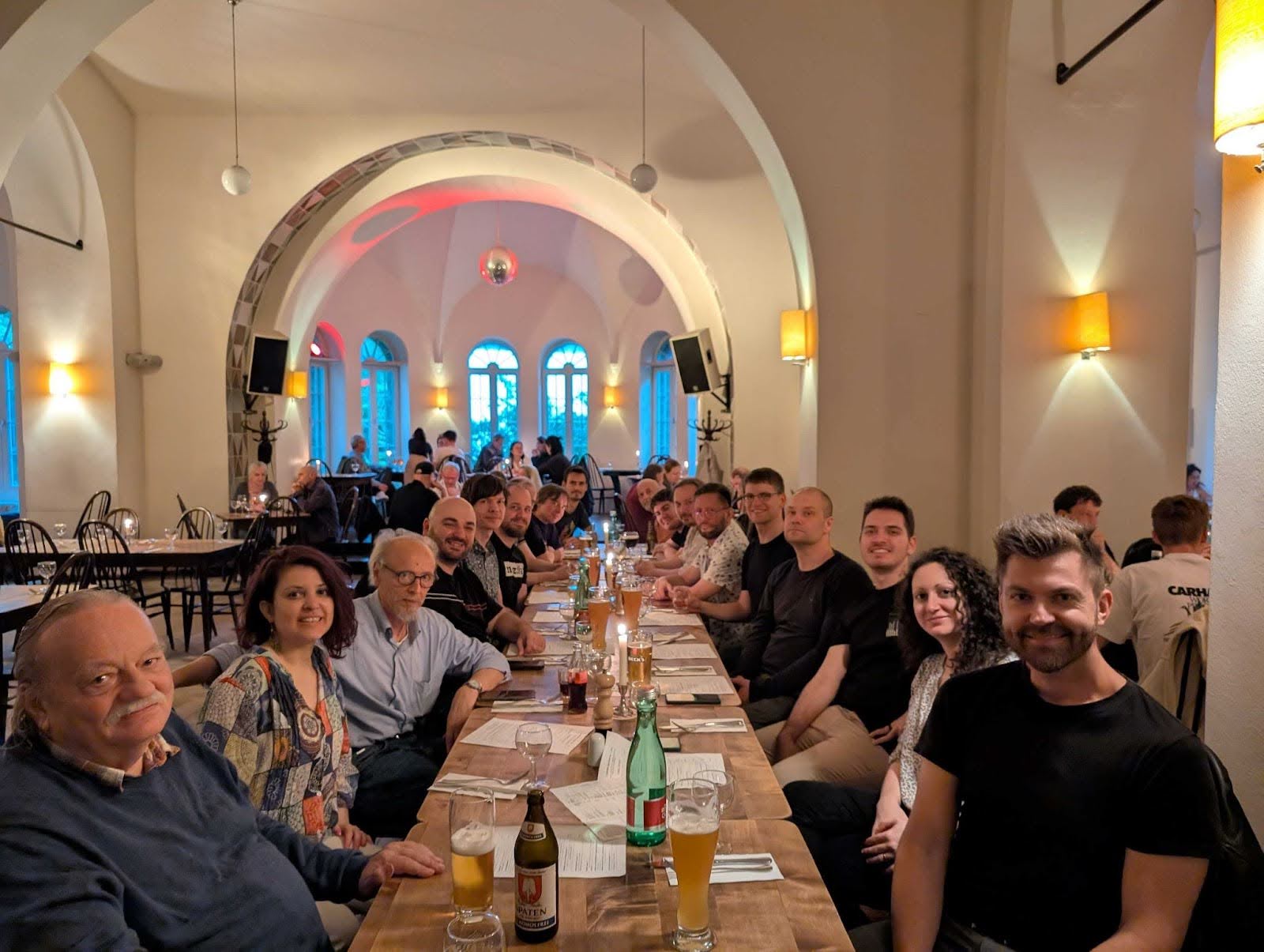
Our main achievement in 2025 was organizing a pilot in-person event in Berlin, reconnecting localizers from around Europe after a long hiatus. Fourteen volunteers from 11 locales spent a weekend together at the Mozilla Berlin office, sharing ideas, discussing challenges, and deepening relationships that had previously existed only online. For many attendees, this was the first time they met fellow contributors they had collaborated with for years, and the energy and motivation that came out of those days clearly showed the value of human connection in sustaining our global community.
 This doesn’t mean we stopped exploring other ways to connect. For example, throughout the year we continued publishing Contributor Spotlights, showcasing the amazing work of individual volunteers from different parts of the world. These stories highlight not just what our contributors do, but who they are and why they make Mozilla’s localization work possible.
Internally, these spotlights have played an important role for advocating on behalf of the community. By bringing real voices and contributions to the forefront, we’ve helped reinforce the message that investing in people — not just tools — is essential to the long-term health of Mozilla’s localization ecosystem.
What’s coming in 2026
As we move into the new year, our focus will shift to exploring alternative deployment solutions. Our goal is to make Pontoon faster, more reliable, and better equipped to meet the needs of our users.
This excerpt comes from last year’s blog post, and while it took longer than expected, the good news is that we’re finally there. On January 6, we moved Pontoon to a new hosting platform. We expect this change to bring better reliability and performance, especially in response to peaks in bot traffic that have previously made Pontoon slow or unresponsive.
In parallel, we “silently” launched the Mozilla Language Portal, a unified hub that reflects Mozilla’s unique approach to localization while serving as a central resource for the global translator community. While we still plan to expand its content, the main infrastructure is now in place and publicly available, bringing together searchable translation memories, documentation, blog posts, and other resources to support knowledge-sharing and collaboration.
On the technology side, we plan to extend plural support to iOS projects and continue improving Pontoon’s translation memory support. These improvements aim to make it easier to reuse translations across projects and formats, for example by matching strings independently of placeholder syntax differences, and to translate Fluent strings with multiple values.
We also aim to explore improvements in our machine translation options, evaluating how large language models could help with quality assessment or serve as alternative providers for MT suggestions.
Last but not least, we plan to keep investing in our community. While we don’t know yet what that will look like in practice, keep an eye on this blog for updates.
If you have any thoughts or ideas about this plan, let us know on Mastodon or Matrix!
Thank you!
As we look toward 2026, we’re grateful for the people who make Mozilla’s localization possible. Through shared effort and collaboration, we’ll continue breaking down barriers and building a web that works for everyone. Thank you for being part of this journey.
No comments yet
Post a comment