About you
My name is Cláudio Esperança, I’m from Portugal. I speak Portuguese and English. I have been contributing to Mozilla localization projects for more than 18 years.
Mozilla localization
Q: How did you first get involved in localization, and what drew you to Mozilla?
A: Curiosity has always driven me to understand how things work. Discovering open-source software, specifically Firefox and Linux, opened a world of limitless possibilities. I saw software translation not only as a way to improve my English but also as a great opportunity to start collaborating and contributing to the Mozilla mission. I began by following the community email list, contributing translations, and attending events. Before I knew it, I was leading the Portuguese translation team.
Q: You contribute across many projects in Pontoon. Is there a product that stands out to you? Have you shared with family and friends what you have been doing and promoting the products?
A: Firefox is always my favorite and the browser I use most regularly, as I trust it with my personal data. However, I contribute to all projects to provide users with more people-focused, secure, and private options, in a market often dominated by other vested interests.
I don’t actively promote my work, as I prefer when people discover Mozilla products because they are the best solution for their needs. It may seem counterintuitive, but actually, I love when I see someone using Firefox, or another Mozilla product, not because they feel pressured by something I said, but because they’ve discovered it’s the best solution for them. It is very gratifying to know that the strings I translate are used by thousands of people every day, including family, friends, coworkers, and many other people which I probably will never know.
Q: What have been some of the most rewarding or impactful projects you’ve localized?
A: Firefox is undoubtedly the most impactful due to its fundamental role on the web. I also found Firefox OS particularly interesting: the concept was great, and it had great potential, but unfortunately it didn’t go as far as I would have liked. I still hope to see it reborn in some form one day.
Q: What advice would you give to someone considering contributing to Mozilla localization today?
A: One of the best things about L10n at Mozilla is how accessible localization has become. You don’t need to be a developer to make a difference. Whether by starting with a smaller project to build up confidence or diving straight into a high-impact application, or focus on a tool you love or explore something entirely new, the choice is yours. The most important step is simply to begin. And there’s no such thing as a ‘small’ contribution — every translated word helps to build a more inclusive internet for everyone.
Community & leadership
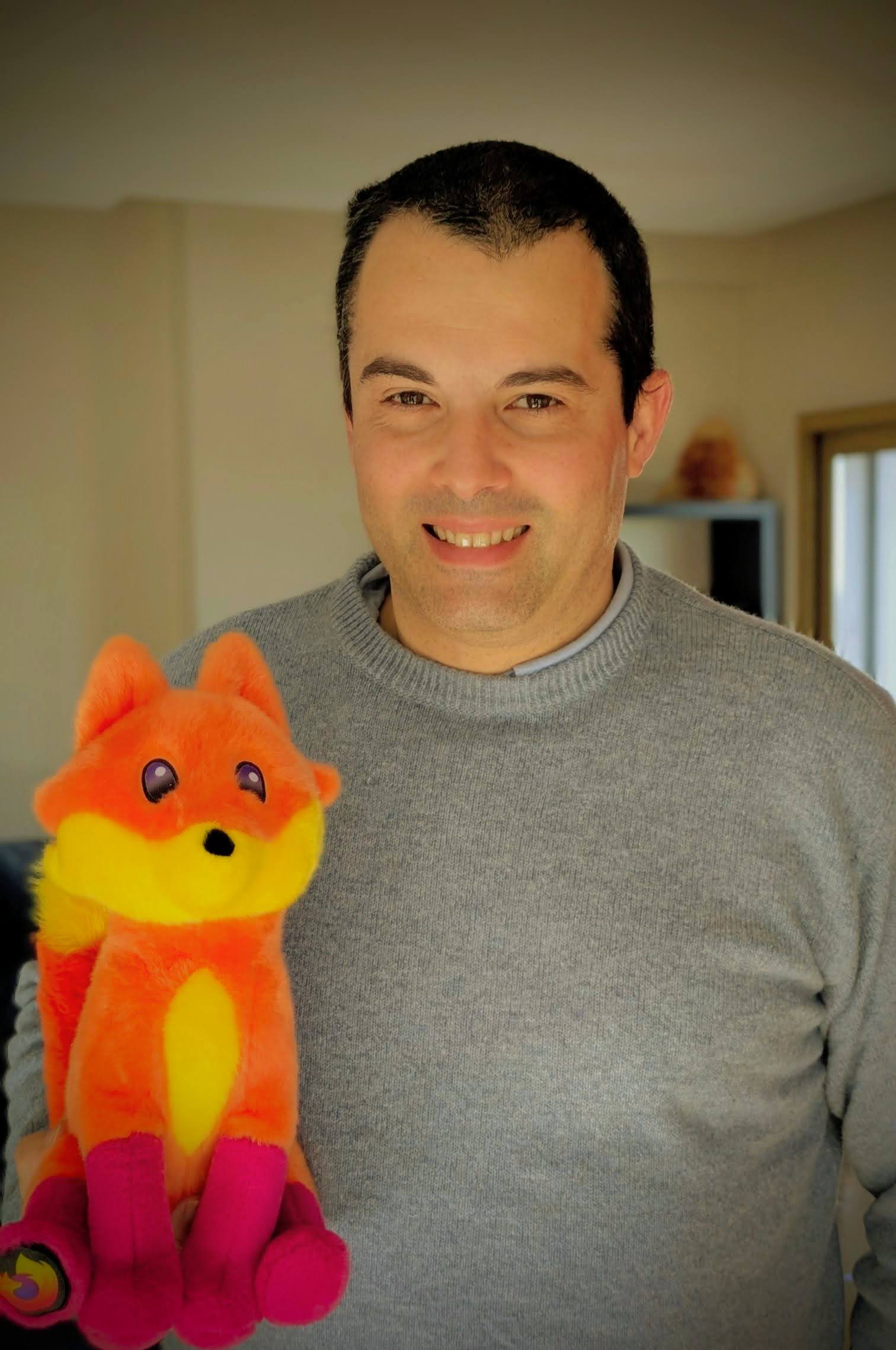
Cláudio and Kit, celebrating 18+ years of Mozilla localization.
Q: How does the Portuguese localization community collaborate today?
A: The Portuguese community is small, and we don’t have many members with recurring contributions. One of the reasons they give for this disengagement is that they feel their help isn’t needed because our translation completion rate is high (which isn’t true at all). There are other reasons like lack of time (main reason), and the fact that a large portion of the user base are pretty comfortable using software in English, Brazilian, or Spanish.
Regarding community communication, while we previously used various discussion groups, we now primarily communicate via email and direct contact, with most of the work happening directly on Pontoon.
Q: You’ve been leading the team for many years. How do you approach mentorship and conflict resolution?
A: When I started, I didn’t have a mentor, so I had to rely on Mozilla’s resources and some reverse engineering. Today, platforms like Pontoon and SUMO make the process much easier for volunteers. Regarding conflicts, like all communities, we sometimes face significant challenges regarding personality and linguistic differences. Overall, we try to maintain a positive, constructive, and inclusive attitude, where all well-founded contributions are welcome. We use a democratic process for most decisions, with a “benevolent dictator” model as a final fallback if consensus cannot be reached.
Professional background & skills
Q: What is your professional background, and how has it influenced your localization work?
A: I have a background in software engineering (Master’s in Mobile Computing, Bachelor’s in Information Systems, technical training in TCP/IP networks, Linux, and other technologies). This experience helps me handle technical aspects of software translation like placeholder syntax, HTML tags, and technical terminology, though modern tools like Pontoon have made localization much more accessible to everyone.
Q: How has localization influenced your professional work?
A: Localization provides a unique perspective on applications by allowing a deeper understanding of how they work. We get to learn about the various options available in the software, sometimes hidden in the more obscure areas of the application. Unlike more traditional applications that rely on older technologies, applications developed within the Mozilla ecosystem are at the forefront of web innovation, allowing early exposure to the future of the Internet. As a software engineer, I incorporate these insights into my own projects to create more modern and user-friendly solutions.
Q: After 18+ years, what keeps you motivated to continue contributing?
A: Our mission remains unfinished. We have a responsibility to ensure the internet remains a global public resource that doesn’t require English as a barrier to entry. In an era where AI and massive platforms are consolidating power, the need for diverse alternatives has never been more urgent. Localizing Mozilla products into my native language is my way of practicing digital activism. It’s incredibly rewarding to know that a handful of translated sentences can improve the lives of so many people instantly. The mission continues…
Interesting facts
Q: Tell us something unexpected about yourself.
A: How someone born on an island in the Azores, who lived in half a dozen different cities in a country as small as Portugal, and who has worked as a farmer, shepherd, beekeeper, construction worker, electrician, trainer, programmer, and software engineer ended up translating world-class open-source software is a difficult story to explain. Ultimately, I think it all comes back to curiosity…
No comments yet
Post a comment