Please note some of the information provided in this report may be subject to change as we are sometimes sharing information about projects that are still in early stages and are not final yet.
Welcome!
Are you a locale leader and want us to include new members in our upcoming reports? Contact us!
What’s new or coming up in Firefox desktop
Firefox string deadline changes
Starting with 149, some changes in developer deadlines relating to Nightly and Beta have resulted in a slight shift in string translation deadlines, giving us 2 extra days to land strings. Previously deadlines in Pontoon were set to the Sunday ahead of the final Release Candidate but going forward they will be set to a Tuesday. For example the upcoming deadline for Firefox 151 is Tuesday, May 12.
If you’re interested to see more details on upcoming Firefox releases and milestones, https://whattrainisitnow.com has all the latest details.
UI Refresh
Behind the scenes a refresh on the visual look of Firefox has been ongoing using the internal name “Nova”. You may have seen some blog reports recently on this, or perhaps have been seeing bugs in Bugzilla with this in the title. We will start seeing new strings related to these changes here and there as development work progresses, however we don’t expect a large number of string changes stemming from this work.
That being said, these updates also bring some changes in how we communicate directly to our users within Firefox. One of these changes you may have already met: our new mascot Kit. If you missed the announcement give it a read here. You may also notice a shift voice for user directed messages — with source strings becoming more Genuine, Fiery, and Playful. See this recent update in Firefox’s brand voice for more details.
Settings redesign
Localization for the update to about:settings has been going on for some time (starting early this year) and the bulk of the translation work is behind us at this point. You may see some new strings (particularly around Privacy & Security) but many of the strings are in a viewable/testable state in Nightly 152. You can check your translations and test out the redesign by typing about:config into your URL bar, proceeding past the warning message, and searching for browser.settings-redesign.enabled and setting the value to true.
What’s new or coming up in mobile
Things have been particularly busy on mobile over the past couple of months. For example, Firefox for Android saw a significant spike in April, with the number of new strings increasing to over 200 compared to fewer than 50 in March — more than eight times the typical monthly volume*.
There are two main drivers behind this increase. First, Firefox for Android is introducing a built-in VPN feature, bringing it in line with the functionality already available in Firefox. Second, both iOS and Android teams are working on a new widget for the upcoming 2026 World Cup, allowing users to follow their team directly from the browser.
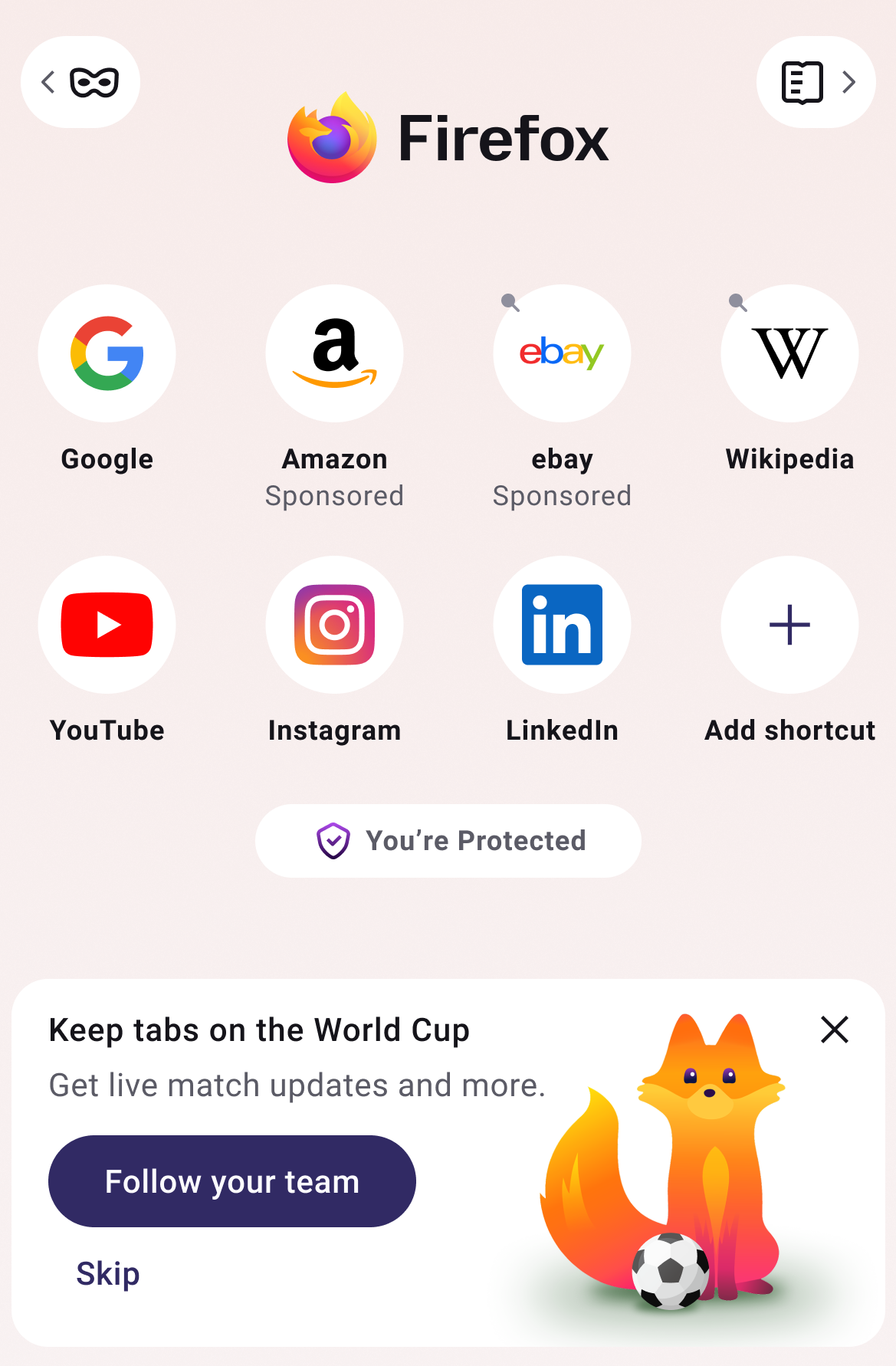 Given the short turnaround time for this feature, you will notice that many strings are intentionally kept consistent across platforms — and started landing on Desktop as well. We’re also pre-landing as many strings as possible, ahead of implementation, to give localizers more time to complete translations.
* Did you know that you can track the number of new strings in a project from the Insights page in Pontoon? Check for example Firefox for Android. In the Translation activity chart, click on New source strings in the legend to display this data. Given the difference in scale, it can also help to hide other metrics to make the chart easier to read.
What’s new or coming up in Pontoon
New documentation system. Pontoon now features a brand-new, unified documentation system. This new hub brings together previously scattered resources into a single, streamlined experience, consolidating developer, localizer, and admin documentation from three separate sites into one cohesive platform. By centralizing content, the new system makes it easier to find, navigate, and maintain documentation, ensuring contributors of all roles have quick access to up-to-date and consistent guidance.
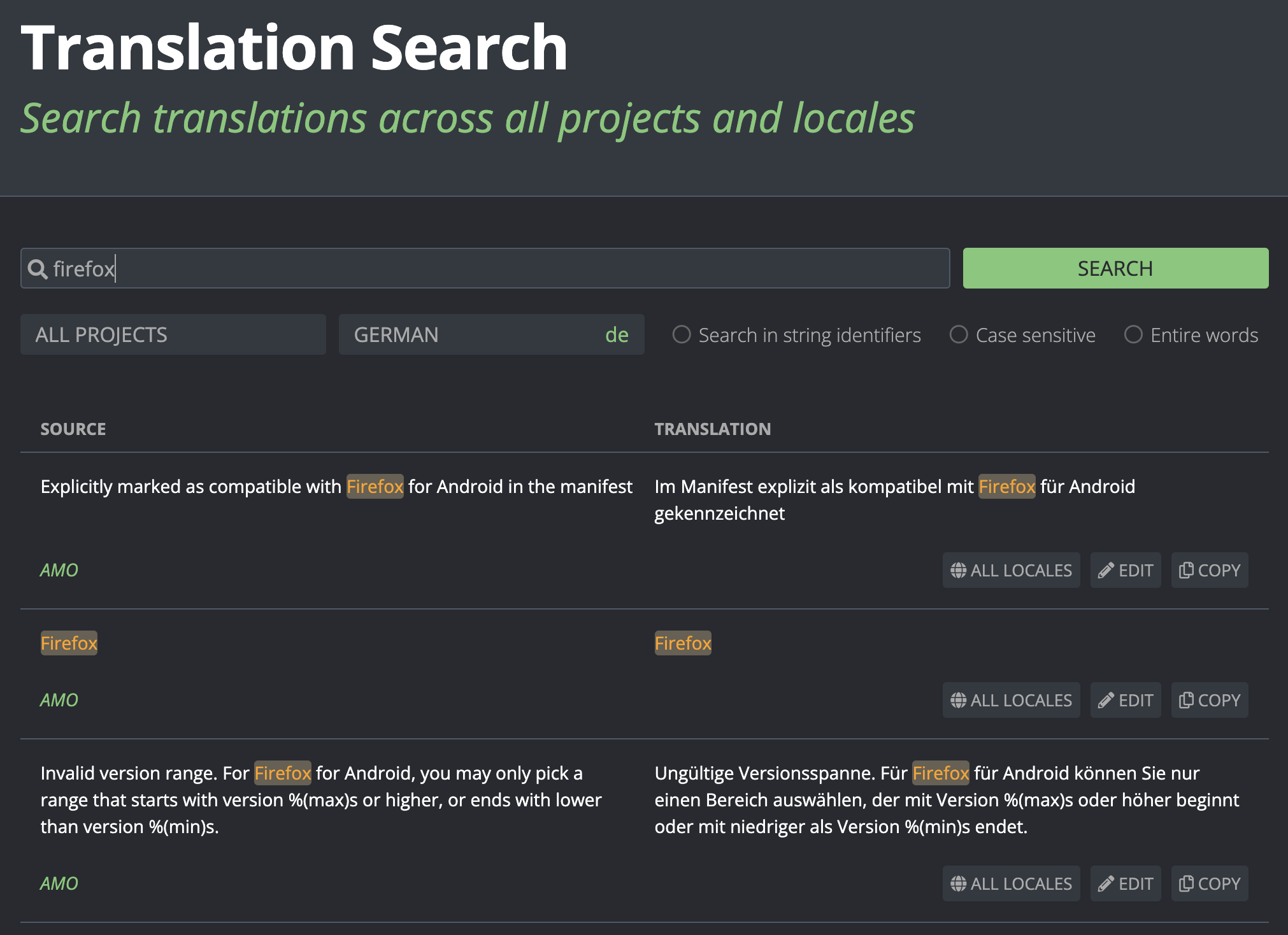
Search. You can now set default search options directly in your profile. This allows you to tailor your search without having to adjust filters each time.
The same settings are also applied when using the recently introduced global search page, which brings a major step forward in unifying localization across Mozilla by allowing users to search for strings across all projects and locales in one place. Inspired by Transvision and designed as its successor, the feature integrates deeply with Pontoon, making it easy to filter results, compare translations across languages, and jump directly into the translation workflow.
 AI integration. We’ve also refined the prompt used by the LLM-powered translation feature. The goal is not to change how the feature works, but to make its output more consistent and better aligned with the context available in Pontoon. For example, the updated prompt improves how punctuation is handled, reducing variability in suggestions.
In addition, the prompt now includes more contextual data:
- String ID.
- Comments, including pinned comments from project managers.
- Matches from terminology.
This additional context helps the model generate more relevant suggestions. It also represents a first step toward making LLM suggestions more useful, ahead of potential experiments with displaying them by default alongside suggestions from traditional machine translation.
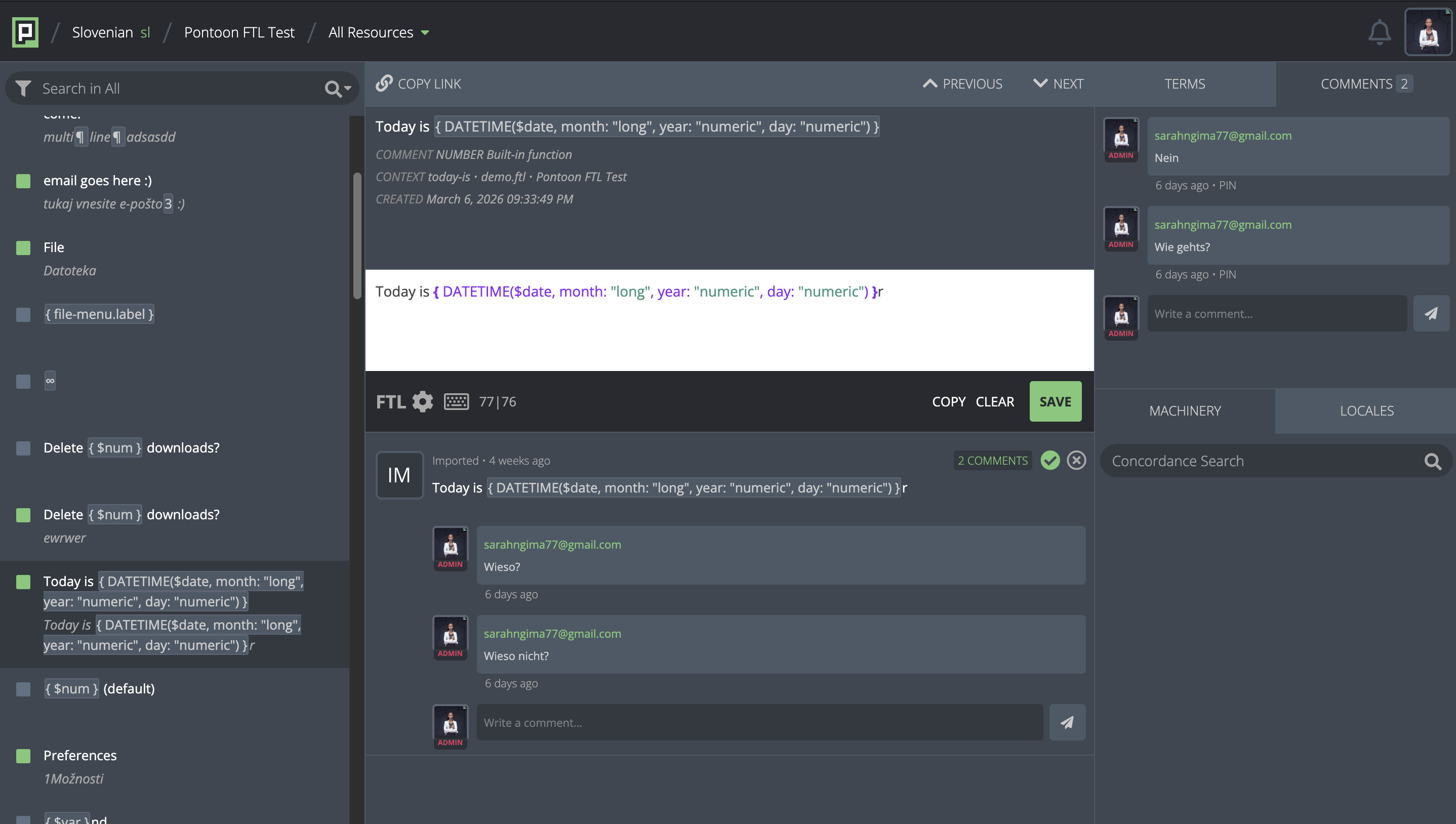
New contributors. We’re also excited to welcome a group of new contributors who have started making an impact on Pontoon over the past few months. MundiaNderi, nishitmistry, dannycolin, first-afk, wassafshahzad, huseynovvusal, and Peacanduck have all contributed valuable improvements across different parts of the project, helping us move faster and improve the overall experience.
A special shoutout goes to Serah (MundiaNderi), who not only made significant contributions but also shared insights into her work in a recent blog post about enhancing comment management in Pontoon—an excellent example of the kind of collaboration and knowledge sharing we love to see in the community.
Newly published localizer facing documentation
As part of the recent documentation update for Pontoon, we’ve reorganized the content around pretranslation to make it clearer and easier to navigate. There is now a dedicated page outlining the criteria required to enable pretranslation for a locale, along with guidance on how to monitor its effectiveness over time (for example, by tracking metrics like acceptance rate or time to review). If you’re a locale manager and want to try pretranslation for your locale, you can request it directly from Pontoon.
Over the past 12 months, we also ran a limited experiment using paid translation agencies for two locales. The goal was to restore the localization level of Firefox for Android in cases where the community was inactive — situations that have since improved, with both communities now active again.
Because volunteer communities remain the foundation of Mozilla’s localization model, we wanted to be transparent about when and why this approach was used, and what it means in practice. This includes clarifying how external support fits within a community-driven ecosystem, where localizers retain ownership and responsibility for quality and direction. You can find more details in this page.
Friends of the Lion

Image by Elio Qoshi
We continue the localizer spotlight series this year.
- Meet Oliver from China Firefox localizer, accounting student, former Minecraft translator, and Bocchi the Rock! fan He talks about starting with a single typo, why Firefox’s independence matters to him, and how the Simplified Chinese community keeps quality high with cross-review and shared responsibility.
- Marcelo from Argentina needs no introduction to the localization communities. From Phoenix 0.3 to 24 years later, he shares how he got started, what it meant to be part of the Firefox 1.0 release, his experience as an l10n manager, and why using Mozilla products in his own language — Spanish (Argentina) — continues to motivate him.
- What does 18 years of volunteer localization look like? From discovering Firefox and Linux out of curiosity to leading the Portuguese translation team, Cláudio from Portugal reflects on why localization is a form of digital activism, and how every translated word helps build a more inclusive internet.
- Baurzhan from Kazakhstan began his localization journey with a simple question: why wasn’t Kazakh available in widely used software? That curiosity grew into a long-term commitment to localization, leading to the successful translation of Firefox and many other open source projects. His work demonstrates the power of perseverance in making technology accessible to all.
If you enjoy the series, please help us identify the localizers you’d like to see featured filling out this nomination form. If you have stories to share, tell us in your own words.
Know someone in your l10n community who’s been doing a great job and should appear here? Contact us and we’ll make sure they get a shout-out!
Useful Links
- #l10n-community channel on Element (chat.mozilla.org)
- Localization category on Discourse
- Mastodon
- L10n blog
Questions? Want to get involved?
If you want to get involved, or have any question about l10n, reach out to:
- Francesco Lodolo (flod) – Engineering Manager
- Bryan – L10n Project Manager
- Peiying (CocoMo) – L10n Project Manager for mozilla.org, marketing, and legal
- Francis – L10n Project Manager for Common Voice, Mozilla Foundation
- Théo Chevalier – L10n Project Manager for Mozilla Foundation
- Kiki – L10n Project Manager for SUMO
- Matjaž (mathjazz) – Pontoon dev
- Eemeli – Pontoon, Fluent dev
Did you enjoy reading this report? Let us know how we can improve it.
No comments yet
Post a comment