About You
My name is Marcelo Poli. I live in Argentina, and I speak Spanish and English. I started contributing to Mozilla localization with Phoenix 0.3 — 24 years ago.
Mozilla Localization Journey
Q: How did you first get involved in localizing Mozilla products?
A: There was a time when alternative browsers were incompatible with many websites. “Best with IE” appeared everywhere. Then Mozilla was reborn with Phoenix. It was just the browser — unlike Mozilla Suite (the old name for SeaMonkey) — and it was the best option.
At first, it was only available in English, so I searched and found an opportunity to localize my favorite browser. There were already some Spanish localization for the Suite, and that became the base for my work. It took me two releases to complete it, and Phoenix 0.3 shipped with a full language pack — the first Spanish localization in Phoenix history.
The most amazing part was that Mozilla let me do it.
Q: Do you have a favorite product? Do you use the ones you localize regularly?
A: Firefox is always my favorite. Thunderbird comes second — it’s the simplest and most powerful email software. Firefox has been my default browser since the Phoenix era, and since many Mozilla products are connected, working on one often makes you want to contribute to others as well.
Q: What moments stand out from your localization journey?
A: Being part of the Firefox 1.0 release was incredible. The whole world was talking about the new browser, and my localization was part of it.
Another unforgettable moment was seeing my name — along with hundreds of others — on the Mozilla Monument in San Francisco.
Q: Have you shared your work with family and friends?
A: Yes. I usually say, “Try this, it’s better,” and many times they agree. Sometimes I have to explain the concept of free software. When they say, “But I didn’t pay for the other browsers,” I use the classic explanation: “Free as in freedom and free as in free beer.”
I wear Mozilla T-shirts, but I don’t brag about managing the Argentinian localization. Still, some tech-savvy friends have found my name in the credits.
Community & Collaboration
Q: How does the Argentinian localization community work together today?
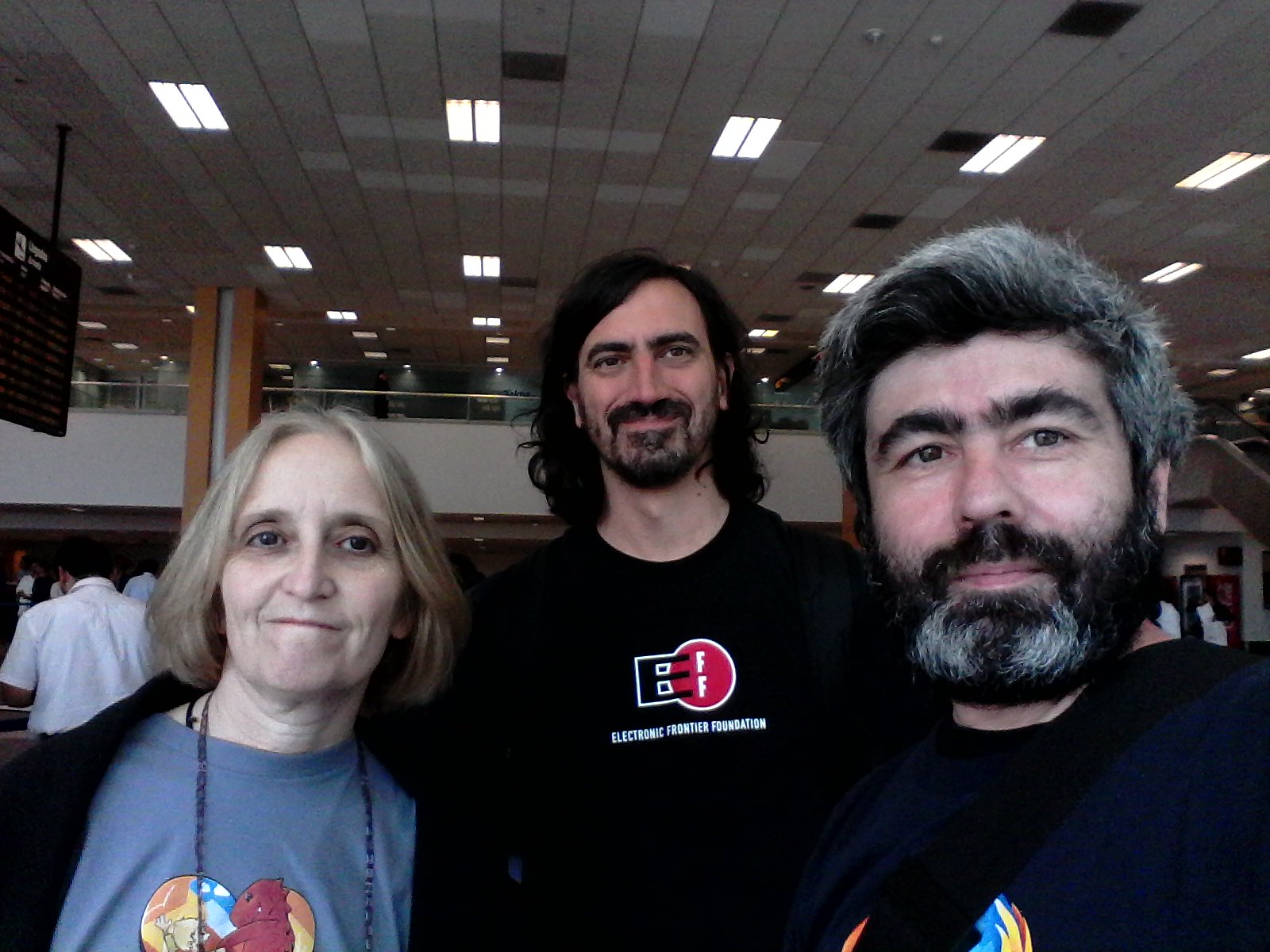
Marcelo (right) with fellow Argentinian Mozillians
Gabriela and Guillermo
A: In the beginning, the Suite localization, Firefox localization, and the Argentinian community were separate. Mozilla encouraged us to join forces, and I eventually became the l10n manager.The community has grown and shrunk over time. Right now it’s smaller, but localization remains the most active part, keeping products up to date. We stay in touch through an old mailing list, Matrix, and direct messages. I’ve also participated in many community events, although living far from Buenos Aires limits how often I can attend.
Q: How do you coordinate translation, review, and testing?
A: We’re a small group, which actually makes coordination easier. Since we contribute in our free time, even small contributions matter, and three people can approve strings at any time.
We test using Nightly as our main browser. Priorities are set in Pontoon — once the five-star products are complete, we move on to others. Usually, the number of untranslated strings is small, so it’s manageable.
Q: How has your role evolved over time?
A: The old Mozilla folks — the “original cast,” you could say — were essential in the early days. Before collaborative tools existed, I explained DTD and properties file structures to others. Some contributors had strong language skills but less technical background.
Since the Phoenix years, I’ve been responsible for es-AR localization. At first, I worked alone; later others joined. Today, I hold the manager title in Pontoon. As Uncle Ben once said, “With great power comes great responsibility,” so I check Pontoon daily.
Q: What best practices would you share with other localizers?
A: Pontoon is easy to use. The key is respecting terminology and staying consistent across the localization.
If you find a typo or a better phrasing, suggest it directly in Pontoon. You don’t need to contact a manager, and it doesn’t matter how small the change is. Every contribution matters — even if it isn’t approved.
Professional Background & Skills
Q: What is your professional background, and how has it helped your localization work?
A: I studied programming, so I understand software structure and how it works. That helped a lot in the early days when localization required editing files directly — especially dealing with encoding and file structure.
Knowledge of web development also helped with Developer Tools strings, and as a heavy user, I’m familiar with the terminology for almost everything you can do in software.
Q: What have you gained beyond translation?
A: Mozilla allows you to be part of something global — meeting people from different countries and learning how similar or different we are. Through community events and hackathons, I learned how to collaborate internationally. As a side effect, I became more fluent speaking English face to face than I expected.
Q: After so many years, what keeps you motivated?
A: My main motivation is being able to use Mozilla products in my own language. Mozilla is unique in having four Spanish localization. Most projects offer only one for all Spanish-speaking countries — or at best, one for Spain and one for Latin America.
I’m not the most social person in the community, so recruiting isn’t really my role. The best way I motivate others is simply by continuing to work on the projects. Many years ago, I contributed a few strings to Ubuntu localization — maybe they’re still there.
Fun Facts
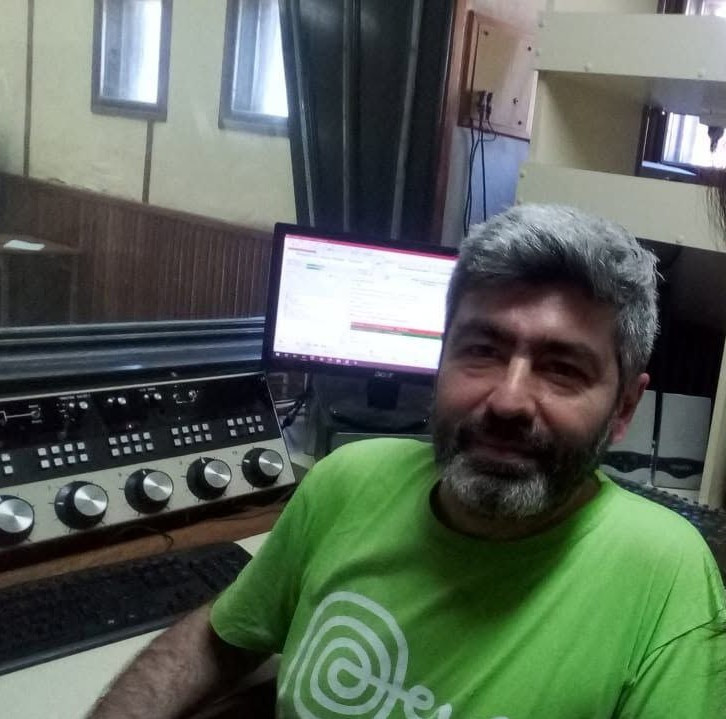
Marcelo as a DJ
I was a radio DJ for many years — sometimes just playing music, sometimes talking about it.
Paraphrasing Sting, I was born in the ’60s and witnessed the first home computers like Texas Instruments and Commodore. My first personal computer was pre-Windows, with text-based screens, and I used Netscape Navigator on dial-up.
I still prefer a big screen over a cellphone and mechanical keyboards over on-screen ones. These days, I’m learning how to build mobile apps.
No comments yet
Post a comment